

Should You Use an App to Track GLP-1 Use? When It Pays Off
Should You Use an App to Track GLP-1 Use? Mostly Yes, With Two Exceptions
Should you use an app to track GLP-1 use? Yes, if you want to tell a normal side effect from a dosing mistake, or a real plateau from a bad week. A notebook can store dates. An app also keeps the context around each dose, and context is what makes the data usable.
The exceptions are real, and we cover them below. If you're stable on a maintenance dose, feel fine and never miss an injection, tracking is optional.
This article is general education, not medical advice. Your prescriber makes dosing decisions.
Should You Use an App to Track GLP-1 Use? What Does It Change?
Tracking changes one thing: it lets you answer "is this normal?" with your own data instead of a guess. Without a record, nausea in week three could be the drug, a late dose, a heavy dinner, or a skipped meal. With a record, you can see which one lines up.
Think about the question people actually type into search boxes at 10pm. "Why do I feel sick since my last shot?" Nobody can answer that for you without the date, the dose, what you ate and how you slept.
That's the gap. A paper log captures the first two. It rarely captures the rest, because writing five things down after every injection is the kind of habit that quietly dies in week five.
Key Takeaways
- Tracking matters most when the dose changes (titration) and when you're troubleshooting a plateau or a side effect.
- Dates and doses alone are weak data. Sleep, food, mood and symptoms next to each dose are what make patterns visible.
- Manual logs fail through friction: the notebook is empty exactly when life gets busy.
- If you're stable, symptom-free and consistent, a simple reminder may be all you need.
- An app earns its place when it connects the log to guidance, not when it just stores numbers.
Does Tracking Your GLP-1 Dose Really Change Outcomes?
Tracking doesn't make the medication work harder. What it changes is your decisions: you catch missed doses sooner, bring a real timeline to your prescriber, and stop second-guessing normal early side effects. The drug does the pharmacology; the record does the interpretation.
We won't quote a "tracking users lose X% more" figure, because we haven't measured one and we'd distrust anyone who did without a source. The honest claim is narrower. Adherence and side-effect timing are the two inputs your prescriber most wants, and both are easy to misremember.
Here's what a useful record contains:
- Dose, date and time of each injection
- Injection site, so you can rotate
- Side effects with severity, not just "felt off"
- Sleep, energy and mood on the same day
- A goal metric such as weight or appetite
If you want the metrics side of this in more depth, our guide on how to track GLP-1 progress when the scale won't move covers what to measure beyond weight.
App vs. Notebook: How Do They Compare?
An app wins on friction, context and pattern detection. A notebook wins on simplicity and privacy-by-default. For a single weekly shot with no complications, both work. The app pulls ahead the moment you have a titration schedule, side effects, or more than one compound.
| Notebook | Tracking app | |
|---|---|---|
| Logging effort | Free-form, easy to skip | Pre-filled dose, sliders, a few taps |
| Missed-dose handling | You notice later, if at all | Reminder within the dose window |
| Injection site rotation | Memory | Recommended automatically from history |
| Pattern spotting | You eyeball pages | Charts overlay symptoms, sleep and doses |
| Sharing with a prescriber | Photograph a page | Exportable summary |
The reminder row is the one most people underestimate. In PeptideIQ, a missed dose triggers a nudge within a six-hour window asking whether you took it and forgot to log, want to take it now, or are skipping. Those options exist because "I think I did it Thursday?" is how double doses and silent gaps happen.
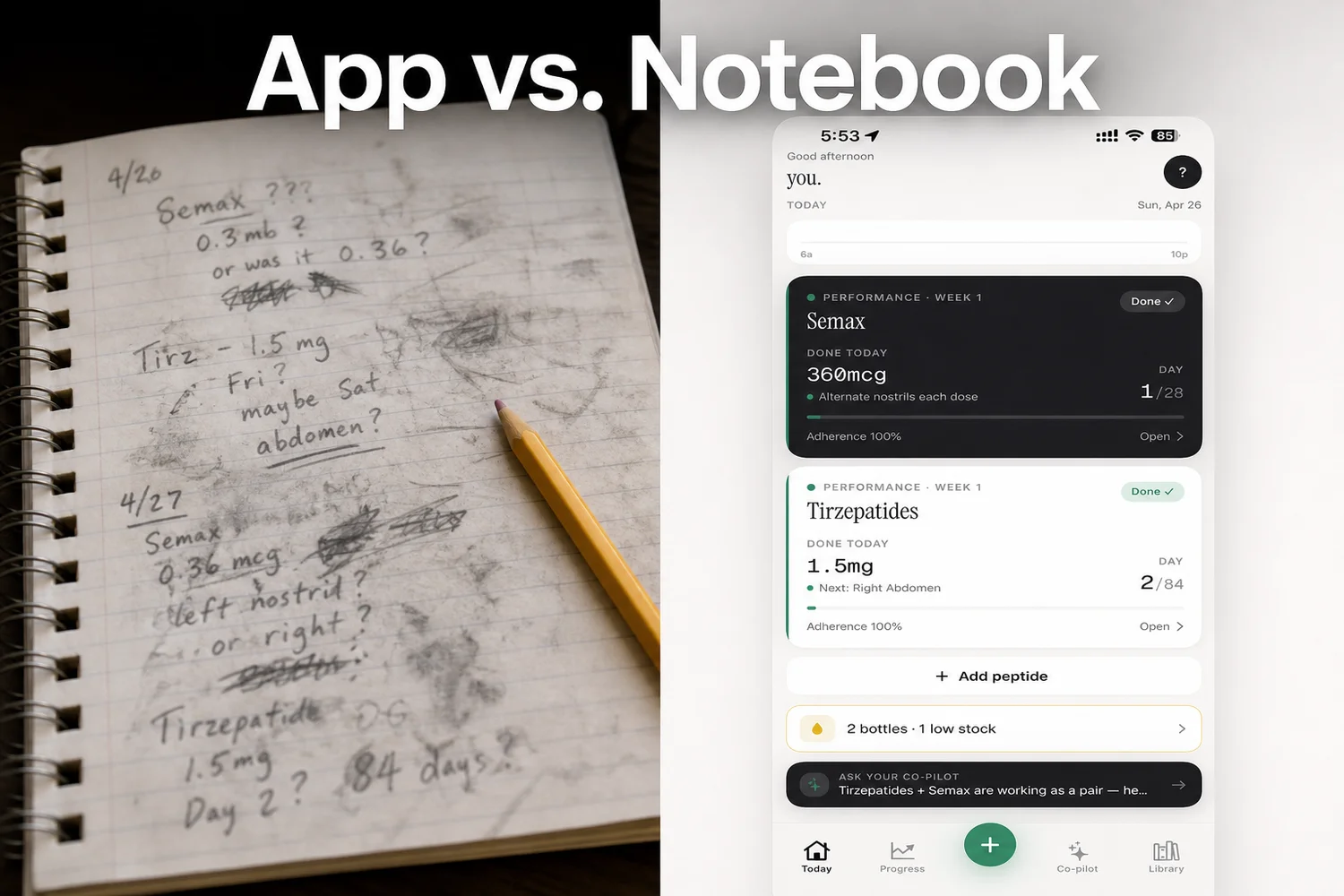 The same two protocols: scribbled, uncertain notes on the left, a day count, dose and adherence line on the right.
What Can an App Tell You That a Notebook Can't?
An app can overlay two variables you'd never line up by hand, such as sleep quality against dose timing, or nausea against dose changes, and flag when a correlation looks meaningful. That's the difference between a diary and an analysis.
A concrete example from product design: PeptideIQ's logging flow captures four quick sliders (energy, mood, sleep, and a goal metric) plus an optional tap-to-select side-effect grid. If energy or mood sits at 4 or below for three check-ins in a row, the app surfaces a prompt rather than waiting for you to notice.
Compare that with a notebook entry reading "Tues, 0.5mg, tired." You have the dose. You've lost why you were tired.
Reality check: Data you never review is just a more expensive notebook. Pick an app that does something with the numbers, or the habit won't last.
The context-aware difference
Most trackers stop at logging. PeptideIQ's co-pilot is built on the opposite premise: it answers with your protocol, cycle day, last seven days of wellness logs and goal already in hand. Asked "I feel really tired today, is that normal?", it responds knowing how many days you're in, what your energy slider has read lately and how you slept, so the answer is yours rather than generic.
Should You Use an App to Track GLP-1 Use, or Skip It?
You benefit most if you're in the first months, adjusting dose, missing injections, dealing with side effects, or combining a GLP-1 with other compounds. You benefit least if you're long-term stable, symptom-free, and already consistent. Be honest about which camp you're in.
The two exceptions to "mostly yes":
- You're stable and bored by it. If you've been on the same dose for months with no issues, a calendar reminder is a perfectly good system.
- Tracking makes you anxious. Some people spiral on daily numbers. If logging becomes obsessive, scale back to dose-and-symptoms only and talk to your prescriber.
For the people who do need it, semaglutide users in particular get the most from structured logging during dose escalation. Our semaglutide tracking app page goes through what to look for there.
When App Tracking Actually Matters Most
App tracking matters most in three moments: when your dose changes, when side effects appear without an obvious cause, and when progress stalls. In each case the question is "what changed?", and only a record can answer it.
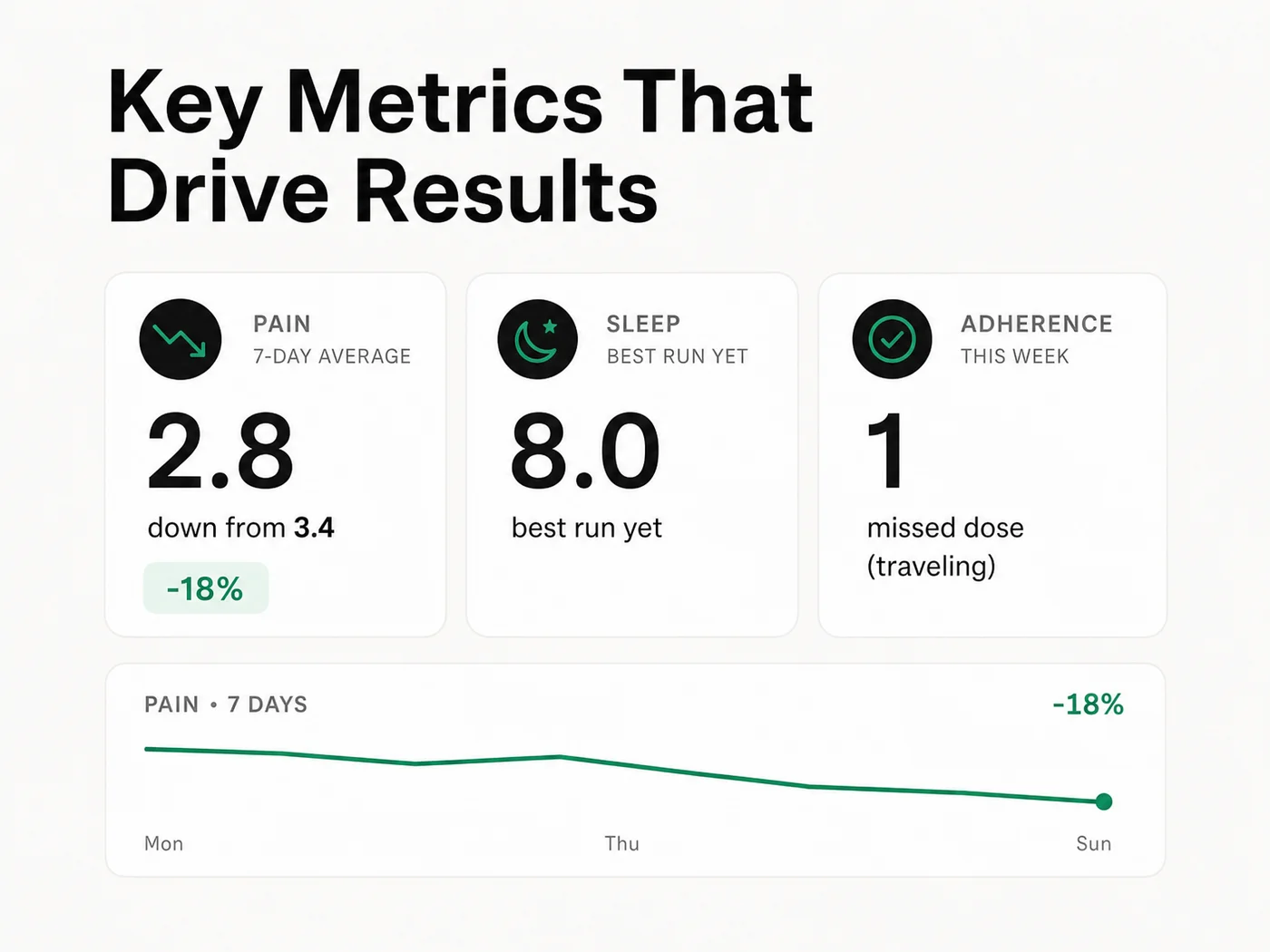 A weekly co-pilot summary reduced to its three signals: outcome trend, sleep, adherence.
The numbers above come from a real co-pilot screenshot, and a note on scope: that example is a BPC-157 week, not a GLP-1 one. It's still the clearest illustration of the idea. The co-pilot reported an average pain score of 2.8, down from 3.4 (an 18% drop), sleep at 8.0, its best run yet, and exactly one missed dose, explained by travel.
Swap "pain" for weight, appetite or nausea and the structure holds. Raw adherence percentage is just a number; "down 18%, matches what you'd expect at this point, one dose missed while traveling" is a decision.
How PeptideIQ Fits In
PeptideIQ is an iOS app for tracking peptide protocols, GLP-1s such as semaglutide and tirzepatide included. Today shows each active protocol with its day count and adherence, and the co-pilot sits one tap away. If you're weighing the whole category, our overview what a peptide tracking app is and whether you need one is the better starting point, and GLP-1 tracking app adherence data goes deeper on the numbers.
PeptideIQ is pre-launch, with the waitlist open now. Android is planned for a later phase.
FAQ
Should you track calories on GLP-1?
Not necessarily. Many people on GLP-1s eat far less without counting, and obsessive calorie logging can backfire. Tracking protein and hydration is often more useful than calories. Ask your prescriber or dietitian what to monitor for your situation.
Is a notebook good enough to track GLP-1 doses?
Yes, if you're consistent and stable. A notebook records dose and date well. It struggles with side-effect timing, missed doses and spotting patterns across weeks. If you find yourself skipping entries or guessing, that's the signal to move to an app.
What should I log every time I inject?
At minimum: dose, date, time and injection site. Add side effects with severity, plus sleep and energy for the day. That small set gives you and your prescriber enough to explain a rough week or confirm a good one.
Is my tracking data private?
In PeptideIQ, health data is encrypted at rest, you can export everything as JSON or CSV, and deleting your account removes data from servers within 30 days. Check any app's privacy policy before you log health information.