
How to Track GLP-1 Progress Beyond the Scale | PeptideIQ
How to Track GLP-1 Progress When the Scale Won't Move
Week 4. Four injections in, and the number on the bathroom scale looks almost the same as it did on day one. Your appetite is quieter, you are a little tired, and you are wondering if the medication is doing anything at all.
That moment is where most people either quit or start guessing. Learning how to track GLP-1 progress properly means measuring the right things at the right rhythm.
This article is general education, not medical advice. Your prescriber sets your dose and your targets.
What Tracking GLP-1 Progress Actually Means
Tracking GLP-1 progress means recording more than your weight: your doses and whether you took them on schedule, how you feel each day, side effects and their severity, and appetite changes. Weight is one data point. The pattern across all of them tells you whether the protocol is working.
Most people start and stop with the scale. That is understandable, since weight is the number everyone asks about. But it is also the noisiest number you have, and the slowest to respond in the first month.
A useful log answers four questions:
- Did I take the dose, and when?
- How did I feel today: energy, mood, sleep?
- Did any side effect show up, and how bad was it?
- What is the weight trend, not today's weight?
If you can answer those four every week, you are tracking. If you only have a handful of scattered weigh-ins, you are guessing with a number attached.
Why Does Weight Fluctuate So Much on GLP-1?
Daily weight swings on GLP-1 are mostly water, digestion and food volume, not fat. Sodium, hydration, constipation, your last meal and where you are in your menstrual cycle can each move the scale by a pound or more in a day, which can hide a real downward trend.
GLP-1 medications also slow stomach emptying. That means what you ate yesterday can still be on board when you step on the scale today.
Early on, it gets even more confusing.
The standard semaglutide label schedule starts at 0.25 mg once weekly for four weeks, then steps up to 0.5 mg. That starter dose is built for tolerance, not for maximum weight loss, so a slow first month is expected. We cover what is typical in how much weight to lose in 5 weeks on semaglutide.
How Often Should You Check Your Progress on Semaglutide?
Log doses and symptoms daily, but judge weight on a weekly average and review the whole picture once a week. Daily weigh-ins are fine if you only look at the trend line. Reading meaning into a single morning is how people talk themselves out of a working protocol.
Think of it as three layers:
- Daily, 60 seconds: dose taken, energy, mood, sleep, any side effect.
- Weekly, 5 minutes: average weight, adherence, side-effect pattern, anything that changed (a travel week, a new dose, a rough night).
- Every 4 weeks: zoom out. Is the trend moving in the direction your prescriber and you expected?
The weekly review is the one that matters. It is also the one most people skip, because without a summary in front of them it means opening a spreadsheet and doing arithmetic.
How to Track GLP-1 Progress Beyond the Scale
Weight tells you where you are. These tell you why, and whether it will last.
Adherence. A missed or late dose changes your results more than most diets do. Logging each dose, with the date, makes a gap visible instead of something you vaguely remember.
Side effects, with severity. Nausea on injection day that fades by day three is a different story from nausea that builds all week. Rating each symptom mild, moderate or severe gives your prescriber something specific to work with. If you want a primer on what is expected, read GLP-1 side effects: what's normal and what isn't, then log and track side effects against it.
Energy, mood and sleep. A simple 1-to-10 rating each day looks trivial. Over six weeks, it shows you whether a dose increase cost you energy, or whether a rough week lines up with a missed dose.
Context. Stress, a holiday, a travel week, a change in protein intake. One short note beats a perfect memory.
 Seven days logged in a row says more about your protocol than any single weigh-in.
None of these metrics is exciting on its own. Together they are the difference between "nothing is happening" and "the trend is flat because I missed two doses and slept badly."
How to Track GLP-1 Progress Week by Week
Results arrive in layers, and the scale is usually the last one to move.
| Window | What often shows up first | What to log |
|---|---|---|
| Weeks 1-4 | Appetite changes, early side effects | Doses, hunger, nausea, energy |
| Weeks 5-8 | First dose step-up, weight trend starts to bend | Weekly average weight, side-effect changes |
| Weeks 9-12 | Clearer trend, routines settle | Adherence rate, measurements, how clothes fit |
| Beyond 12 | Slower, steadier change | Monthly review with your prescriber |
For scale, the STEP 1 trial reported an average loss of about 15% of body weight with semaglutide 2.4 mg, but over 68 weeks. A few weeks is the warm-up, not the whole story. If you want to measure GLP-1 results honestly, compare a four-week average to the previous four-week average, not today to yesterday.
Why Most People Fail to Track GLP-1 Progress (And How PeptideIQ Fixes It)
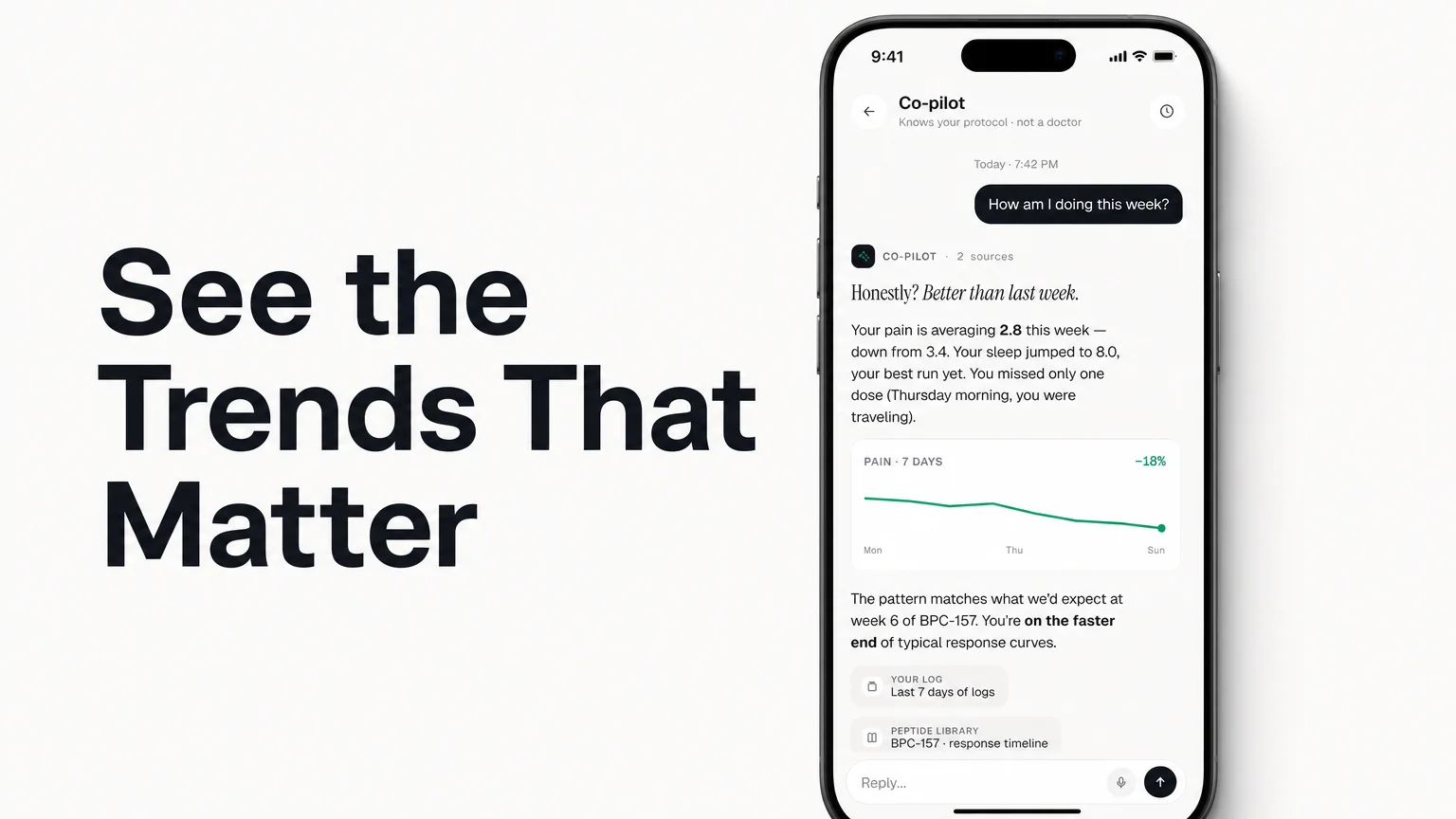 A weekly summary turns seven days of logs into one readable answer.
People rarely fail because they don't care. They fail because tracking asks for too much, and gives back too little.
A spreadsheet demands effort every day and returns nothing until you build the charts yourself. A weight-only app gives you a line that bounces. Neither connects your dose log, your symptoms and your weight in one place, so the pattern never becomes visible.
PeptideIQ is built around that gap.
Dose logging takes about a minute: confirm the dose, set four quick sliders for energy, mood, sleep and your goal metric, tap any side effects with a severity, and add a note only if you want to. Then the app does the part a spreadsheet can't. A weekly insight card summarizes what actually happened that week, and the co-pilot answers from your own logs.
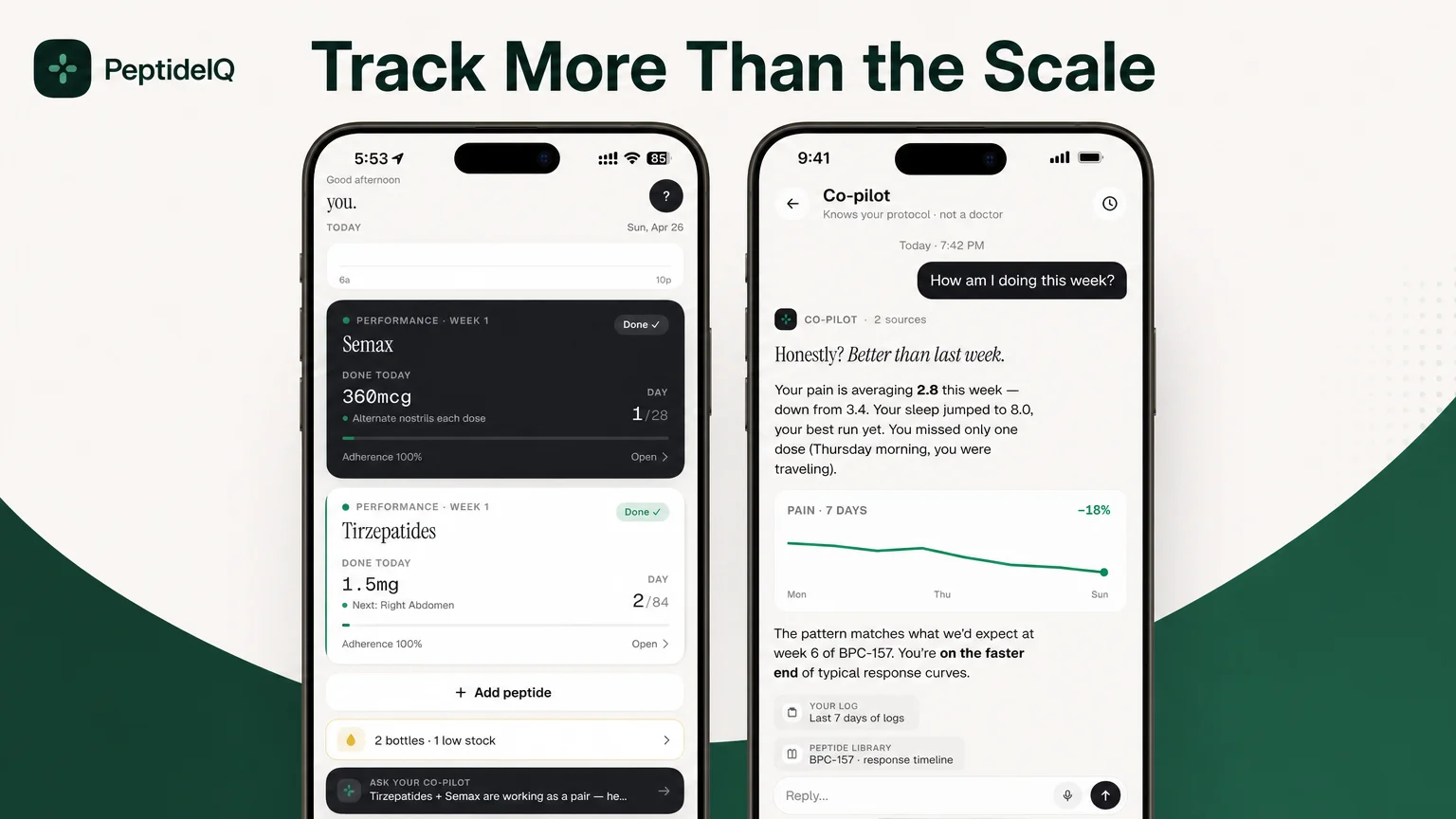
Here is what that looks like in the real app. The Today screen shows each active protocol with its day count and adherence, for example a Tirzepatides protocol at day 2 of 84 with 1.5 mg logged and adherence at 100%. The co-pilot screen answers "How am I doing this week?" with specifics: a 7-day trend, a sleep score, and the one dose missed while traveling.
To be clear about the example: that co-pilot screenshot shows a BPC-157 protocol and a pain score, not GLP-1 weight data. We use it because it shows the format honestly. For a GLP-1 user, the goal metric slider adapts to weight, and the same weekly view applies.
If you are weighing tools, our guides on the best GLP-1 tracking app and what to look for in a semaglutide tracking app go through the criteria, and what a peptide tracking app is explains the structured peptide tracking system behind it. The case for structured tracking comes down to one thing: loose notes can't show a trend.
How Do You Know If GLP-1 Is Actually Working for You?
You know GLP-1 is working when several signals move together over weeks: appetite is lower, doses are consistent, your weekly average weight trends down, and side effects are manageable. One flat week does not mean failure. Four flat weeks with good adherence is the cue to talk to your prescriber.
Use your log to answer in order:
- Did I take every scheduled dose? If not, fix that first.
- Is my weekly average weight going down, even slowly?
- Is appetite or food noise lower than before?
- Are side effects tolerable and not escalating?
If the answers are yes, yes, yes, yes, the scale is catching up. If adherence is solid and nothing has moved for several weeks, bring your logs to your prescriber. A clean record of dose dates, weights and symptoms turns a vague "it's not working" into a conversation you can act on.
Quick recap
- Track doses, symptoms, energy and context, not only weight.
- Look at weekly averages. Single weigh-ins mostly measure water.
- Log daily for 60 seconds, review once a week for five minutes.
- Judge results over 4-week windows, and bring your logs to your prescriber.
Get Started with PeptideIQ
If you want weekly summaries instead of a spreadsheet, PeptideIQ is the iOS app that combines dose logging, wellness check-ins and an AI co-pilot that reads your own data. It is pre-launch, with a waitlist open now.
FAQ
How often should I weigh myself on GLP-1?
Daily weigh-ins work if you only read the weekly average. If daily numbers stress you out, weigh two or three times a week at the same time of day. Either way, judge progress over four-week windows, not single readings.
What should I track besides weight on semaglutide?
Track each dose and its date, energy, mood, sleep, side effects with severity, and appetite. Add brief context notes for travel, stress or diet changes. Together these explain why weight moves or stalls, which weight alone cannot.
Why is my weight not changing on GLP-1?
Early on, the starter dose is built for tolerance, so a slow first month is common. Water retention, missed doses and digestion also hide fat loss. If doses are consistent and nothing moves for several weeks, ask your prescriber to review your plan.
Is it normal to lose nothing in the first few weeks?
Yes, it is common. Appetite effects build gradually and the scale lags behind. Keep logging doses and symptoms, and compare four-week averages. Contact your prescriber sooner if side effects are severe or getting worse.
Does PeptideIQ track GLP-1 medications?
Yes. PeptideIQ supports semaglutide and tirzepatide protocols alongside other peptides, with dose logging, wellness sliders, side-effect tracking and weekly AI insight cards. It is an iOS app, currently pre-launch with a waitlist at peptideiq.io.