
BPC-157 TB-500 Blend Dosage Per Day | PeptideIQ
BPC-157 TB-500 Blend Dosage Per Day: How Much to Take
A standard BPC-157 TB-500 blend dosage per day runs 250-500 mcg of BPC-157 alongside a TB-500 share of roughly 285-570 mcg — the daily-split version of TB-500's usual 2-4 mg weekly total. Exact numbers shift with your vial's concentration and body weight, which is the part most vendor labels skip entirely.
One stat worth sitting with: FDA testing found up to 40% of online peptide products carry incorrect dosages or undeclared ingredients — so the math you do yourself matters more than the label you trust.
 A blended vial only tells you total mg per bottle — turning that into a daily draw is a separate calculation.
What Is the Standard BPC-157 TB-500 Blend Dosage Per Day?
Most protocols land on 250-500 mcg of BPC-157 combined with 285-570 mcg of TB-500 per day, drawn from a single blended vial rather than two separate ones. These figures come from splitting BPC-157's standard daily range and TB-500's weekly range across seven days rather than dosing TB-500 in two or three larger weekly shots.
BPC-157 alone typically holds at 250-500 mcg daily regardless of blending — see the BPC-157 dosage reference guide for the full solo-dosing breakdown. TB-500 is different — most solo protocols dose it as 2-4 mg once or twice weekly, not daily. Blending changes that math:
- BPC-157 share: 250-500 mcg per day, unchanged from solo dosing
- TB-500 share (daily-split): 2-4 mg ÷ 7 days ≈ 285-570 mcg per day
- Typical blend ratio: many vendor vials combine the two at roughly 1:2 (BPC-157 to TB-500) by total milligram content
That ratio is a starting reference, not a rule. Vial concentrations vary by supplier, and a blend labeled "10mg/10mg" delivers a very different daily dose than one labeled "5mg/10mg." Read the label's total mg per vial before assuming any of these numbers apply directly to yours — the BPC 157 dosing chart breaks down standard ranges by experience level if you want a visual reference next to these figures.
For readers who want the fuller protocol picture beyond daily amounts — cycle structure, injection-site rotation, and how the blend compares to running BPC-157 and TB-500 separately — the BPC-157 TB-500 complete stack protocol covers that ground.
Key Takeaways
- Standard BPC-157 TB-500 blend dosing ranges from 250-500 mcg of BPC-157 plus 2-4 mg of TB-500 per day, though exact doses depend on vial concentration and your body weight.
- When dosing a blended vial, calculate your daily amount by multiplying the vial's concentration (mcg/ml or mg/ml) by the volume you draw — the app removes this math anxiety.
- Most users find 5-7 days per week dosing effective; daily injections during the first 2-4 weeks then tapering to alternate days or 3-4x weekly maintains therapeutic levels.
- BPC-157 TB-500 blends simplify your injection routine compared to separate vials, reducing preparation time and improving adherence.
- Tracking your daily dose, injection site, and recovery metrics over time is how you actually know if the blend is working — guessing is not reliable.
How Do You Calculate Your Exact BPC-157 TB-500 Blend Dosage Per Day?
Multiply your blended vial's concentration (mg or mcg per ml) by the volume you draw, then check that figure against both peptides' standard ranges before you inject. Skipping this step is the single most common blend-dosing mistake — assuming a "standard dose" without knowing what your specific vial actually delivers per ml.
If you haven't mixed a vial before, the BPC-157 reconstitution walkthrough covers the BAC water basics this calculation builds on. Here's a worked example using a common vendor spec — say a blend vial lists 10 mg BPC-157 and 20 mg TB-500 reconstituted with 3 ml of bacteriostatic (BAC) water:
- Find the concentration per peptide. 10 mg ÷ 3 ml = 3.33 mg/ml BPC-157. 20 mg ÷ 3 ml = 6.67 mg/ml TB-500.
- Decide your target BPC-157 dose. Say you want 400 mcg (0.4 mg) daily.
- Solve for volume. 0.4 mg ÷ 3.33 mg/ml ≈ 0.12 ml — about 12 units on a U-100 insulin syringe.
- Check the TB-500 side of that same draw. 0.12 ml × 6.67 mg/ml ≈ 0.8 mg — well inside the daily-split 285-570 mcg-to-1mg-plus range some higher-concentration blends use.
Common mistake: Assuming every blend uses the same BPC-157-to-TB-500 ratio. Two vials both labeled "BPC-157/TB-500 blend" can differ by 2x in concentration — always calculate from the actual mg-per-vial number on your specific label.
This is exactly the calculation PeptideIQ's reconstitution calculator automates — enter your vial's total mg, your BAC water volume, and your target dose, and it returns the precise syringe units to draw, with a visual syringe line marking exactly where to stop.
How Should You Time Your BPC-157 TB-500 Blend Injections?
Pick one consistent time — commonly morning on an empty stomach or evening before bed — and hold that window for the full cycle rather than chasing an "optimal" hour. Timing a blend is simpler than timing two separate peptides, since both compounds arrive in a single daily draw instead of two schedules to coordinate.
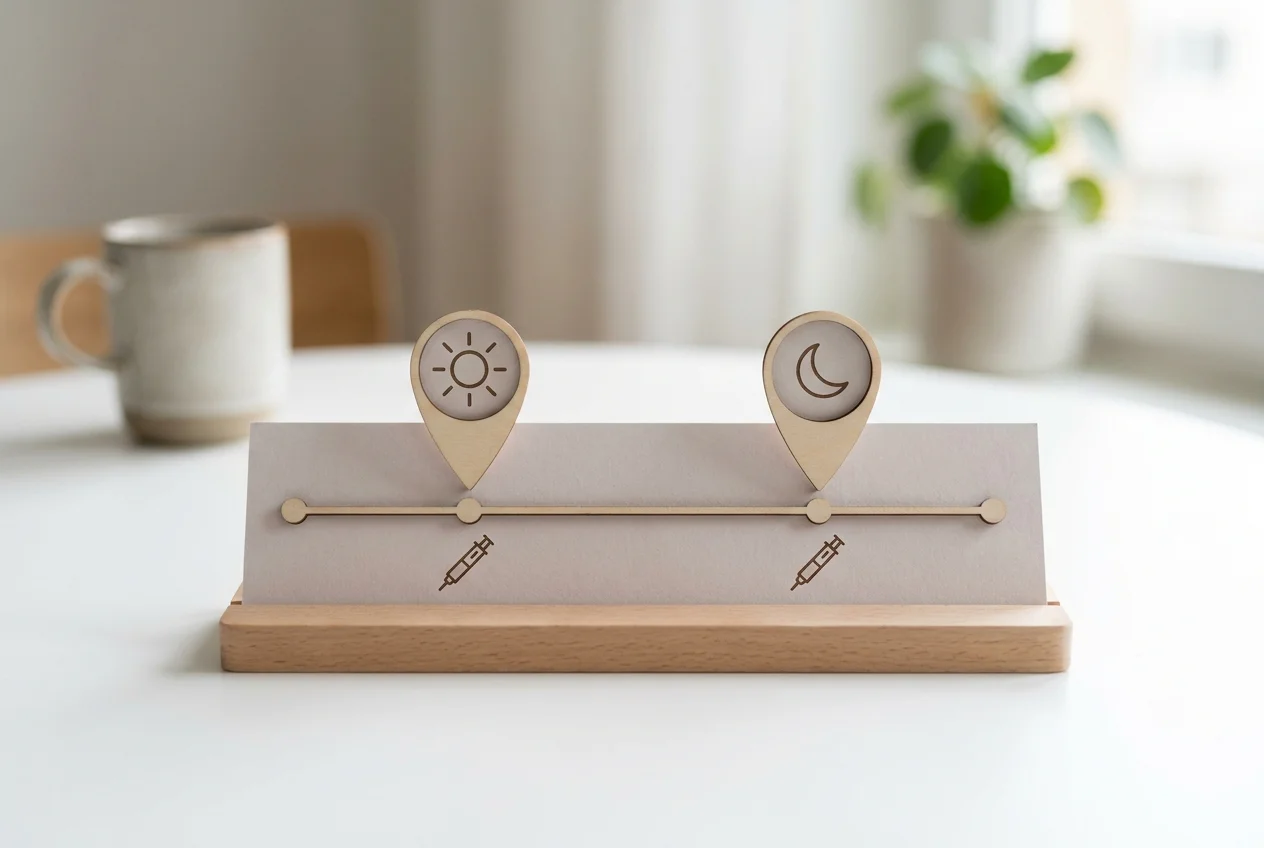 Consistent timing matters more than the exact hour — same window, every day, beats an optimized-but-inconsistent schedule.
Injecting near the affected area (for localized injuries) or subcutaneously in the abdomen (for systemic use) both work with a blend; the injection method doesn't change based on how the vial was formulated.
Daily dosing consistency is the variable that actually predicts outcomes here, more than the specific hour you choose.
Should You Inject Your Blend Once or Twice Daily — and Does the Dose Change Over Time?
Once vs. Twice-Daily Injections
Splitting the daily total into two smaller injections — say, half in the morning and half in the evening — is common for users targeting more stable blood levels throughout the day. A single daily injection is simpler and still effective for most recovery goals.
There's no strong evidence that twice-daily splitting outperforms a single daily shot at the same total dose. The choice mostly comes down to what feels manageable — one injection means less prep time, while two smaller shots can ease soreness at higher total volumes.
How Your Dose Shifts Over a Cycle
Many protocols start at the lower end of the range — 250 mcg BPC-157 / roughly 285 mcg TB-500 daily-equivalent — for the first week, then move to the standard 400-500 mcg / 500-570 mcg range once tolerance is established. Doses generally don't climb indefinitely; they plateau at the standard range for the remainder of a 4-8 week cycle.
Tapering to alternate-day or 3-4x-weekly dosing near the end of a cycle is common practice, particularly once initial healing markers or pain scores improve.
Why PeptideIQ Tracks BPC-157 TB-500 Blend Dosing
 The same math shown above, done automatically every time you log a dose.
A notebook can hold a number. It can't recalculate your dose when you switch to a new vial with a different concentration, and it won't flag that you've logged declining pain scores for three days straight. That's the gap between logging a blend and actually managing one.
PeptideIQ's reconstitution calculator handles the concentration math from the worked example above automatically, then saves it to your vial's inventory record so you're not re-deriving it every injection day. The app's injection site rotation and dose history log also mean you always know which sites you've used recently and whether today's dose matches yesterday's.
Download PeptideIQ on the App Store to get the reconstitution calculator, dose tracking, and recovery-metric logging built specifically for blended protocols like this one.
FAQ
How much BPC-157 and TB-500 are typically in one blended vial?
Vendor blends vary widely, but common specs range from 5mg/10mg to 10mg/20mg (BPC-157/TB-500) per vial. Always check your specific label's total mg content before calculating a daily dose — never assume a "standard" concentration applies to your vial.
Can you take a BPC-157 TB-500 blend every day, or do you need rest days?
Daily dosing without rest days is standard for the first 2-4 weeks, after which many users shift to every-other-day or 3-4x-weekly injections. Rest days at that stage mainly protect injection sites from overuse — they aren't a compound-safety requirement.
What's the difference between blend dosing and dosing BPC-157 and TB-500 separately?
A blend combines both peptides in one vial and one injection, simplifying prep and timing versus drawing two separate syringes. The total mcg delivered can be identical either way — the difference is convenience and injection frequency, not the underlying dose.
How long should a BPC-157 TB-500 blend cycle last?
Standard cycles run 4-8 weeks, matching solo BPC-157 and TB-500 protocols — the blend format doesn't change the underlying cycle length. Longer cycles are sometimes used for chronic or slow-healing injuries, typically followed by a rest period of several weeks before restarting.