
BPC-157 Dosing Chart: Doses, Weight & Cycle
BPC 157 Dosing Chart: Standard Doses, Timing, and Cycle Length
Most people mixing their first vial of BPC-157 are working from a printed forum post, a half-remembered TikTok, and a guess at how the units on their syringe relate to the mcg number they read online. A BPC-157 dosing chart exists to close that gap — turning "somewhere around 250 to 500 mcg" into the exact number that matches your vial, your syringe, and your cycle week.
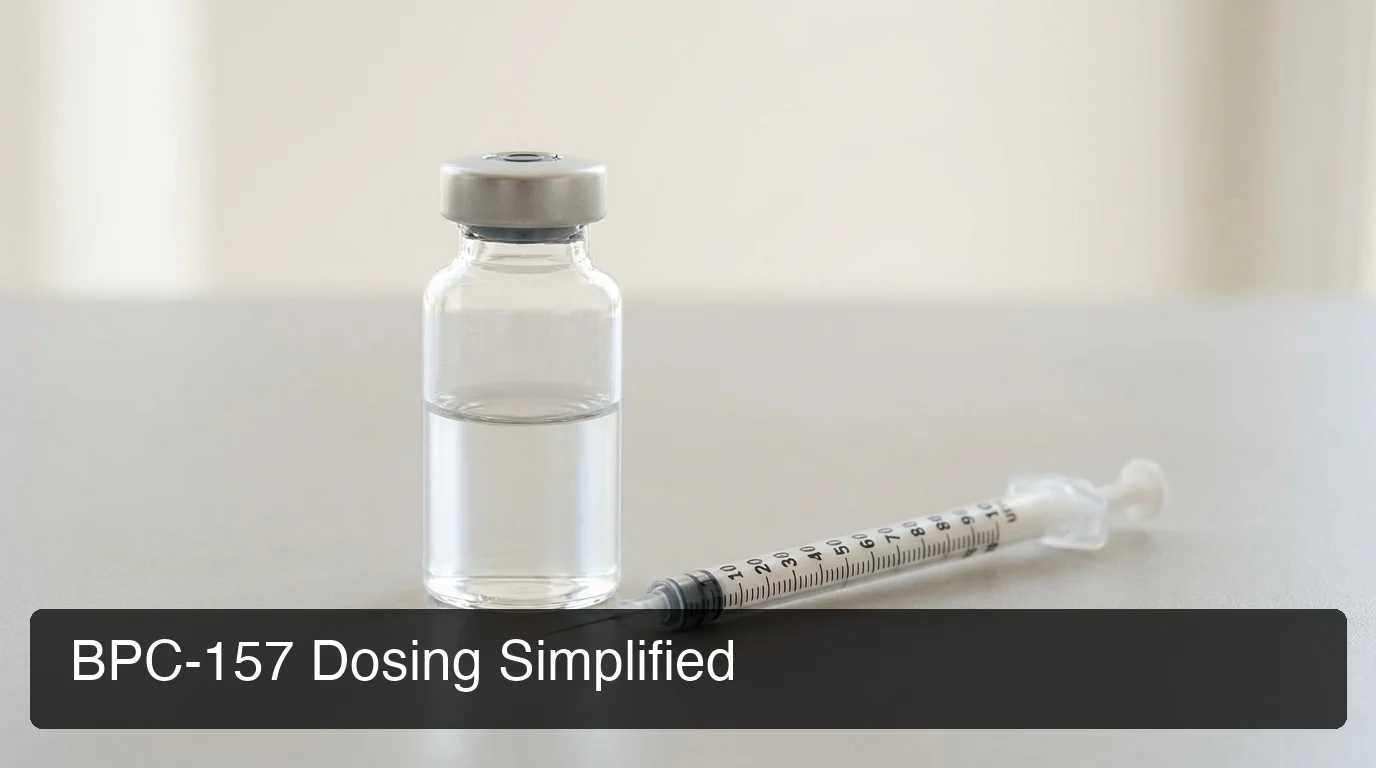 Reconstituted BPC-157 vial with a syringe drawn to a specific unit mark — the endpoint every dosing chart is trying to help you reach accurately.
Key Takeaways
- Standard BPC-157 dosing ranges from 250–500 mcg per injection, with most beginner protocols using the 250–300 mcg range.
- BPC-157 dosing does not scale with body weight like some peptides — the same dose works for a 150 lb person as a 220 lb person.
- Most effective BPC-157 cycles run 6–12 weeks of consistent daily or twice-daily dosing to maximize recovery and healing results.
- Accurate dosing requires proper reconstitution: knowing your vial concentration and calculating exact syringe units to draw prevents under/over-dosing.
- Tracking your actual doses in an app — not guessing or logging in Notes — is how you know if your protocol is working or if you need adjustments.
Contents
- What Is the Standard BPC-157 Dosing Chart?
- How Much BPC-157 Should You Take Per Injection?
- Does Your Weight Affect Your BPC-157 Dosing Chart?
- How Do You Calculate Your BPC-157 Dose After Reconstitution?
- What's the Difference Between BPC-157 Oral vs. Injection Dosing?
- How Do You Adjust Your BPC-157 Dosing Chart Over a Cycle?
- Can Beginners Use the Same BPC-157 Dosing Chart as Experienced Users?
- Why Does Accurate BPC-157 Dosing Matter for Injury Recovery?
- How PeptideIQ Removes Dosing Confusion from Your Protocol
- Frequently Asked Questions
What Is the Standard BPC 157 Dosing Chart?
The standard BPC-157 dosing chart runs 250–500 mcg per injection, taken once or twice daily, with most beginner protocols starting at the low end — 250–300 mcg — before any adjustment. Doses are typically delivered subcutaneously near the injury site using an insulin syringe, and most cycles hold at one dose level for the full 6–12 week protocol instead of escalating.
Here's how that breaks down by experience level and use case:
| Profile | Dose per Injection | Frequency | Typical Cycle Length |
|---|---|---|---|
| Beginner | 250–300 mcg | Once daily | 6–8 weeks |
| Standard / experienced | 300–500 mcg | Once or twice daily | 6–12 weeks |
| Acute injury, higher need | 400–500 mcg | Twice daily | 4–6 weeks, then reassess |
These ranges come from the compounding pharmacy protocols and self-reported community data that dominate BPC-157 use, since it isn't FDA-approved and has no official prescribing chart. Every number above assumes subcutaneous injection — oral capsule dosing runs differently, which the oral vs. injection section below covers.
How Much BPC-157 Should You Take Per Injection?
Most users inject 250–500 mcg per dose, with the exact number depending on the reason for use rather than body size. Injury recovery protocols targeting a specific joint or tendon tend to sit at 300–400 mcg twice daily, while general maintenance or gut-health use often stays at 250 mcg once daily.
The mcg number only matters if it's accurate at the syringe. A vial reconstituted at 5 mg in 3 mL of BAC water produces a very different unit count than the same 5 mg in 5 mL — same peptide, same intended dose, different draw.
Common mistake: Copying someone else's "I draw to the 10 unit line" advice without checking their vial concentration against yours. Two users on the exact same 300 mcg protocol can need completely different unit marks depending on how they reconstituted.
Does Your Weight Affect Your BPC 157 Dosing Chart?
No — BPC-157 dosing does not scale with body weight the way some compounds do. A 150 lb person and a 220 lb person typically use the same 250–500 mcg range, because BPC-157's mechanism works locally at the injury or tissue site rather than through a whole-body dose-response curve tied to mass.
This surprises people coming from a weight-loss peptide background, where dose scales with body composition. BPC-157 is closer to a topical-acting healing compound than a systemic hormone in this respect — location and injury severity drive dose decisions more than the number on the scale.
How Do You Calculate Your BPC-157 Dose After Reconstitution?
Reconstitution math converts a vial of freeze-dried powder into a usable liquid concentration, then that concentration determines the exact syringe units for your target mcg dose. A 10 mg vial mixed with 10 mL of BAC water produces a 1 mg/mL (1,000 mcg/mL) concentration — meaning a 250 mcg dose requires drawing to the 25-unit mark on a U-100 insulin syringe.
This is the step where most dosing errors actually happen — not in choosing 250 vs. 500 mcg, but in getting from powder to syringe without a math mistake.
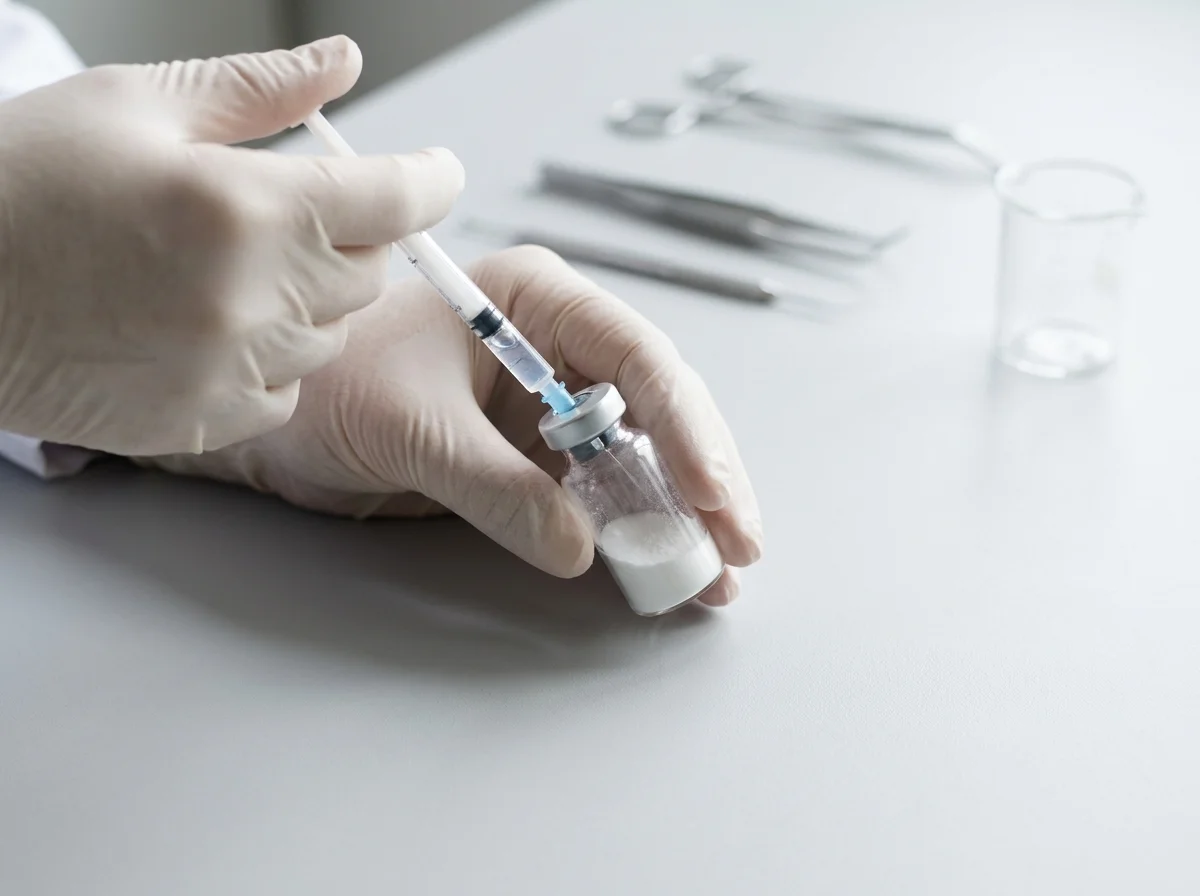 Reconstitution converts vial powder into a working concentration — the number that actually determines your syringe draw.
PeptideIQ's built-in reconstitution calculator was built specifically for this step. You enter three numbers — peptide amount in the vial (mg), BAC water volume you added (mL), and your target dose (mcg) — and it returns the resulting concentration plus the exact syringe units to draw, shown on a visual syringe illustration with the line marked. There's also a reverse mode: enter the units you want to draw and it tells you how much BAC water to add to hit that mark, which is one of the most-requested features from the community. The calculator supports U-100, U-50, and U-30 syringe types, since draw units change depending on which one you're using, and every calculation saves automatically to that vial's record in your inventory.
- Peptide amount in vial (mg) → input
- BAC water added (mL) → input
- Target dose (mcg) → input
- Resulting concentration + exact draw units → output, with visual syringe line
What's the Difference Between BPC-157 Oral vs. Injection Dosing?
Oral BPC-157 capsules require significantly higher doses than injections because gastric acid degrades much of the peptide before absorption — typical oral protocols run 500 mcg to 1 mg or more per day, compared to 250–500 mcg for subcutaneous injection. Injection also delivers the compound closer to the target tissue, which matters for localized injury recovery.
Neither route is inherently wrong; they solve different problems. Injection is the standard for people targeting a specific joint, tendon, or ligament. Oral capsules appeal to needle-averse users or those using BPC-157 for broader gut and systemic support, where localized delivery matters less. If you're still deciding which route fits your situation, how to reconstitute BPC-157 walks through the injection prep process this chart assumes.
How Do You Adjust Your BPC-157 Dosing Chart Over a Cycle?
Most BPC-157 protocols hold a single dose level for the entire cycle rather than escalating like a titration schedule — the adjustment that matters is consistency and injection site rotation, not increasing the mcg amount over time. Cycles typically run 6–12 weeks, followed by a break of at least 2–4 weeks before restarting if needed.
A typical 8-week protocol looks like this in practice:
- Weeks 1–2: Establish the routine — same time, same dose, rotating injection sites to avoid tissue irritation
- Weeks 3–6: Peak reporting window for pain reduction and mobility improvement in most user logs
- Weeks 7–8: Taper toward cycle end; assess whether symptoms have resolved or a second cycle is warranted
 A consistent injection schedule across the full cycle matters more than adjusting the mcg number week to week.
The short version: If you're tempted to increase your BPC-157 dose because week 2 doesn't feel dramatic yet, don't. Most reported improvement happens between weeks 3–6 — mid-cycle dose bumps usually reflect impatience, not a genuine need for more compound.
Can Beginners Use the Same BPC-157 Dosing Chart as Experienced Users?
Beginners should start at the low end of the range — 250–300 mcg once daily — rather than jumping to the 400–500 mcg protocols experienced users often run. The chart's upper range assumes an established injection routine and known individual tolerance, neither of which a first-time user has yet.
Experienced users adjust based on prior cycle data: what dose produced results, how their body tolerated it, and whether twice-daily dosing was worth the added injection. For a broader reference across multiple compounds, the peptide dosage cheat sheet covers where BPC-157 fits relative to other common peptides. A deeper walkthrough of the full protocol, including timing and injection site strategy, is in BPC-157 dosage: the complete reference guide.
Why Does Accurate BPC-157 Dosing Matter for Injury Recovery?
Accurate dosing determines whether you're actually delivering the compound your protocol calls for, or unknowingly under-dosing (no effect) or over-dosing (wasted vial, faster depletion) due to a reconstitution or draw error. Since BPC-157 isn't FDA-regulated, there's no pharmacist double-checking your math — the user is the only quality check in the system.
This is especially relevant for anyone running BPC-157 alongside TB-500, a common stack for injury recovery where the two compounds have different mcg ranges and injection frequencies. Once you're comfortable with solo BPC-157 dosing, BPC-157 TB-500 dosage: the complete stack protocol covers how the two combine without the math getting confused between vials.
How PeptideIQ Removes Dosing Confusion from Your Protocol
 The same dose ranges covered in this chart, built directly into PeptideIQ's Cycle Planner and reconstitution calculator.
Everything in this chart — the mcg range, the reconstitution math, the cycle-length guidance — is exactly what PeptideIQ's Cycle Planner and reconstitution calculator automate for you. Instead of cross-referencing a chart against your own vial concentration every time you inject, you set your protocol once and the app calculates your exact syringe units for every dose, flags when you're due for your next injection, and rotates your injection site automatically based on your last 48 hours of logged doses.
Download PeptideIQ on the App Store
Frequently Asked Questions
How much BPC-157 should you take daily?
Most daily BPC-157 protocols use 250–500 mcg, split into one or two injections. Beginners typically start at 250–300 mcg once daily, while users targeting a specific injury with twice-daily dosing often use 250 mcg per injection, totaling 500 mcg for the day.
How many doses are in a 5 mg vial of BPC-157?
A 5 mg vial reconstituted with 5 mL of BAC water produces a 1,000 mcg/mL concentration. At a 250 mcg dose, that yields 20 total doses per vial; at 500 mcg per dose, it yields 10 doses — assuming no water is lost to evaporation or waste during draws.
How long does it take for BPC-157 to start working?
Most users report early changes, like reduced pain or improved mobility, within the first 2–3 weeks. The most significant reported improvements typically occur between weeks 3–6 of a consistent cycle, which is why tracking daily doses against symptoms matters more than judging results in week one.
What's the difference between BPC-157 and TB-500 dosing?
BPC-157 doses at 250–500 mcg once or twice daily throughout the cycle. TB-500 uses a loading-to-maintenance structure instead — typically 500–1,000 mcg twice weekly for the first two weeks, then once weekly through week 8, since it has a longer half-life than BPC-157.
Do you need to adjust BPC-157 dose based on body weight?
No. Unlike weight-scaled compounds such as GLP-1 peptides, BPC-157 dosing stays within the same 250–500 mcg range regardless of body weight, since it acts locally at the injury site rather than through a systemic, mass-dependent pathway.
Can you take BPC-157 twice a day?
Yes — twice-daily dosing is common for acute injuries or when using the compound for a specific healing target, typically 250 mcg per injection for a 500 mcg daily total. Once-daily dosing is more common for general maintenance or lower-intensity use cases.