
BPC-157 + TB-500 Dosage: Complete Stack Protocol | PeptideIQ
BPC-157 TB-500 Dosage: The Complete Stack Protocol
Most BPC-157 TB-500 dosage guides give you the mcg numbers and stop there. They skip the reconstitution math, the injection frequency question, and what to do when three weeks in you're not sure anything is working.
Key Takeaways
- BPC-157 doses at 200–300 mcg twice daily (subcutaneous); TB-500 follows a loading-to-maintenance structure — 500–1,000 mcg twice weekly for two weeks, then once weekly through week 8.
- Reconstitution accuracy matters more than most users expect: BAC water volume determines concentration, which determines syringe units, which determines actual dose per injection.
- Most users notice meaningful pain and mobility improvement between weeks 3–6; consistent daily logging is the only way to distinguish real progress from placebo.
- Injection site rotation prevents lipohypertrophy (lumpy deposits from repeated tissue trauma) and maintains consistent absorption across the protocol.
- A tracking system that logs dose timing, wellness check-ins, and weekly metrics turns an 8-week protocol into interpretable data — not just a waiting game.
Contents
- What Is the Correct BPC-157 TB-500 Dosage for a Healing Protocol?
- How Much TB-500 Should You Take With Your BPC-157 Stack?
- How Often Should You Inject the BPC-157 and TB-500 Blend?
- Stacking BPC-157 and TB-500: Injection Site Strategy
- Reconstitution & Dosing Math: How to Calculate Your Exact Syringe Units
- How Long Should You Run a BPC-157 + TB-500 Protocol?
- Can You Adjust Your BPC-157 TB-500 Dosage If Results Aren't Showing?
- What Happens If You Dose Your BPC-157 + TB-500 Stack Incorrectly?
- Why Does Tracking Your BPC-157 + TB-500 Stack Matter?
- Get Started with PeptideIQ
- Frequently Asked Questions
What Is the Correct BPC-157 TB-500 Dosage for a Healing Protocol?
The correct BPC-157 TB-500 dosage: BPC-157 at 200–300 mcg twice daily (subcutaneous), with TB-500 layered on a loading-to-maintenance schedule. Most protocols start both simultaneously, using a morning and evening split for BPC-157 and once-to-twice weekly TB-500 injections. Experienced users scale BPC-157 to 400–500 mcg twice daily for severe soft tissue damage.
BPC-157's approximately 4-hour half-life means a single daily dose creates a meaningful gap in tissue exposure. Two injections per day is the standard approach, not an advanced modification. The morning dose works before training; the evening dose is administered 6–8 hours later regardless of activity.
If you're new to the stack, start at 200 mcg twice daily for the first week before stepping to 250–300 mcg. This establishes a tolerance baseline before adding TB-500's loading volume. For single-peptide dose specifics by injury type and body weight, the BPC-157 dosage reference guide covers the full range of adjustments.
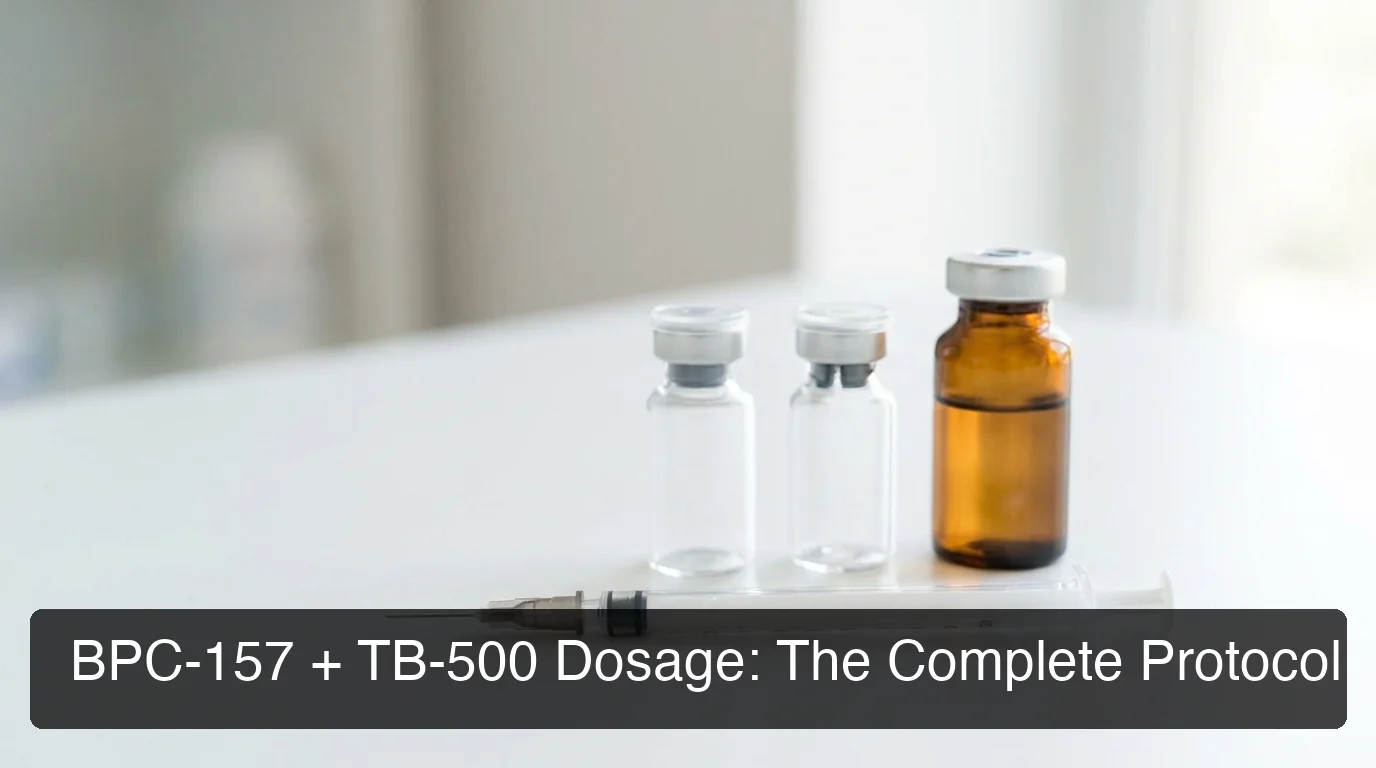 Two vials, bacteriostatic water, and a U-100 insulin syringe — the complete BPC-157 + TB-500 stack setup.
How Much TB-500 Should You Take With Your BPC-157 Stack?
TB-500 (Thymosin Beta-4 fragment) uses a loading-to-maintenance structure. Standard protocols run 500–1,000 mcg twice per week during the first two weeks, then drop to 500–1,000 mcg once per week from week 3 through the end of the cycle. The loading phase saturates tissue; the maintenance phase sustains elevated TB-500 activity without unnecessary injection frequency.
Unlike BPC-157 — which targets tissue by injection proximity — TB-500 works systemically. Injection site placement matters less for therapeutic effect; it matters more for rotation consistency.
| Parameter | BPC-157 | TB-500 |
|---|---|---|
| Standard dose | 200–300 mcg | 500–1,000 mcg |
| Loading frequency | Twice daily | Twice weekly (weeks 1–2) |
| Maintenance frequency | Twice daily | Once weekly (weeks 3–8) |
| Injection type | Subcutaneous, near injury | Subcutaneous, systemic |
| Cycle length | 6–8 weeks | 6–8 weeks (matched) |
| Estimated half-life | ~4 hours | Several days |
| Rest period | 4–6 weeks off | 4–6 weeks off |
Start both peptides simultaneously. Beginning TB-500 two weeks into an existing BPC-157 cycle misaligns the loading phases and makes it harder to assess the combined effect at any given week.
How Often Should You Inject the BPC-157 and TB-500 Blend?
BPC-157 is injected twice daily throughout the entire cycle. TB-500 is injected twice weekly in weeks 1–2 (loading), then once weekly from week 3 onward. Total injections per week: 14 BPC-157 doses plus 1–2 TB-500 doses — a workload that requires a consistent schedule, not a flexible one.
The twice-daily BPC-157 cadence is where most beginners drift first. They start well and slide toward once-daily by week 3. BPC-157's short half-life means missed doses create actual gaps in therapeutic tissue concentration — not just a smaller weekly volume.
Quick win: Set two fixed injection windows daily — one before your morning routine, one before sleep. Fixed times remove the "did I already take it?" question and reduce the decision fatigue that leads to skipped doses over 8 weeks.
For the full picture of what this stack is designed to achieve, the BPC-157 + TB-500 peptide stack guide covers mechanism, expected outcomes, and what good response looks like week by week.
Stacking BPC-157 and TB-500: Injection Site Strategy
Injection site rotation is not a cosmetic protocol detail. Injecting into the same 1–2 cm area repeatedly causes lipohypertrophy — localized fat cell hypertrophy and fibrous tissue buildup that reduces absorption efficiency and leaves visible lumps under the skin.
The standard rotation approach divides available subcutaneous tissue into working quadrants:
- Abdomen: Four quadrants (upper left, upper right, lower left, lower right) — at least 2 inches from the navel
- Thighs: Left and right outer thigh, mid-portion
- Shoulders: Left and right deltoid subcutaneous layer
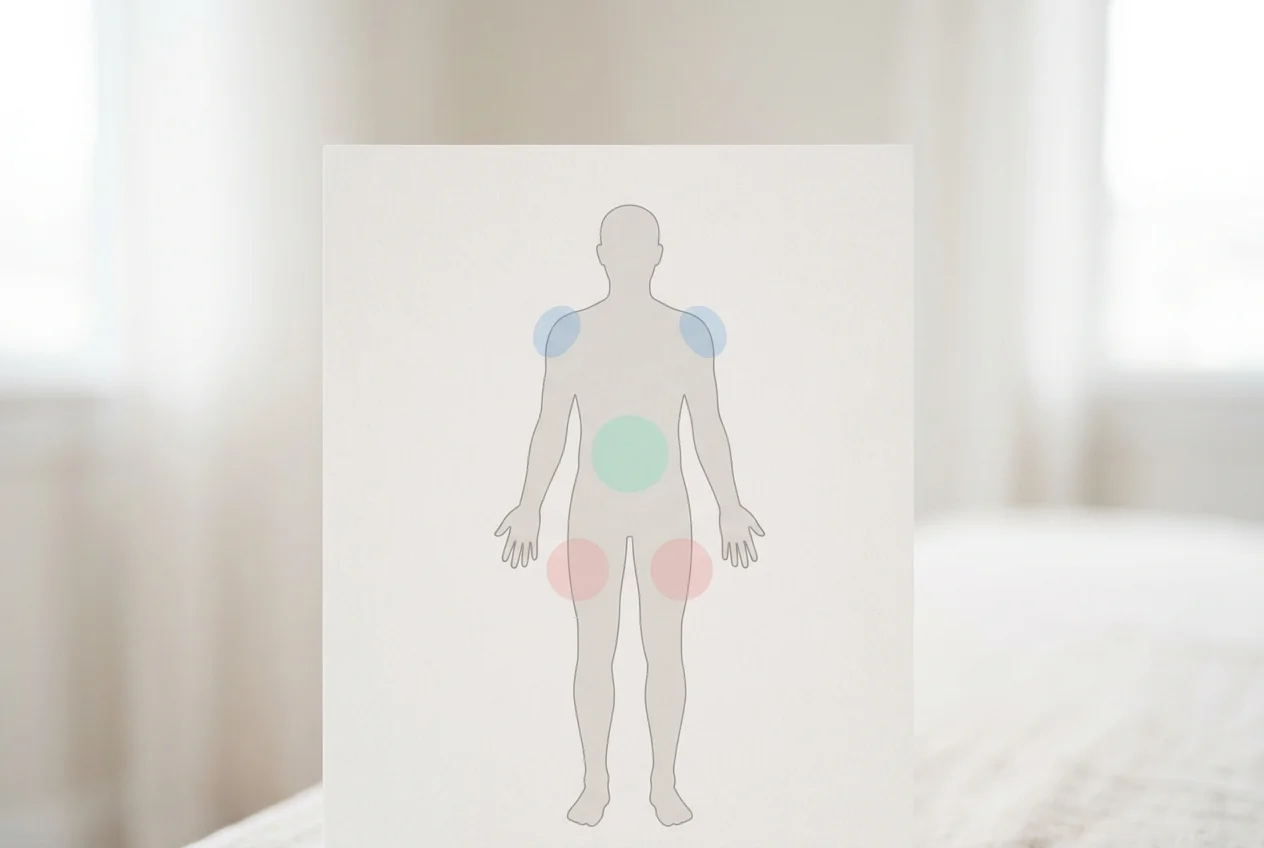 Rotating across at least 6–8 sites across the abdomen, thighs, and shoulders prevents lipohypertrophy and maintains consistent peptide absorption.
For BPC-157 near-injury injections, rotate among 2–3 adjacent points within that proximity zone rather than the exact same spot daily. For TB-500, full systemic rotation across all available sites is the better approach.
Worth knowing: Sites used in the past 48 hours absorb less efficiently due to localized micro-inflammation. Tracking injection site history — alongside dose timing — is part of an accurate protocol, not a bonus step.
Reconstitution & Dosing Math: How to Calculate Your Exact Syringe Units
Most BPC-157 TB-500 dosage errors don't happen at the needle — they happen during reconstitution. The BAC water volume you add determines the concentration, and that concentration determines every syringe unit number for the entire vial's lifetime.
The three-step formula:
- Concentration (mcg/ml) = Total peptide in vial (mcg) ÷ BAC water added (ml)
- Dose volume (ml) = Target dose (mcg) ÷ Concentration (mcg/ml)
- Syringe units (U-100) = Dose volume (ml) × 100
Worked example — BPC-157 5mg vial:
- 5mg = 5,000 mcg total
- Add 2 ml BAC water → concentration = 2,500 mcg/ml → 25 mcg per unit
- For 250 mcg dose: draw to the 10-unit mark
- For 300 mcg dose: draw to the 12-unit mark
Worked example — TB-500 5mg vial:
- Same reconstitution (2 ml BAC water) → 25 mcg per unit
- For 750 mcg loading dose: draw to the 30-unit mark
- For 500 mcg maintenance dose: draw to the 20-unit mark
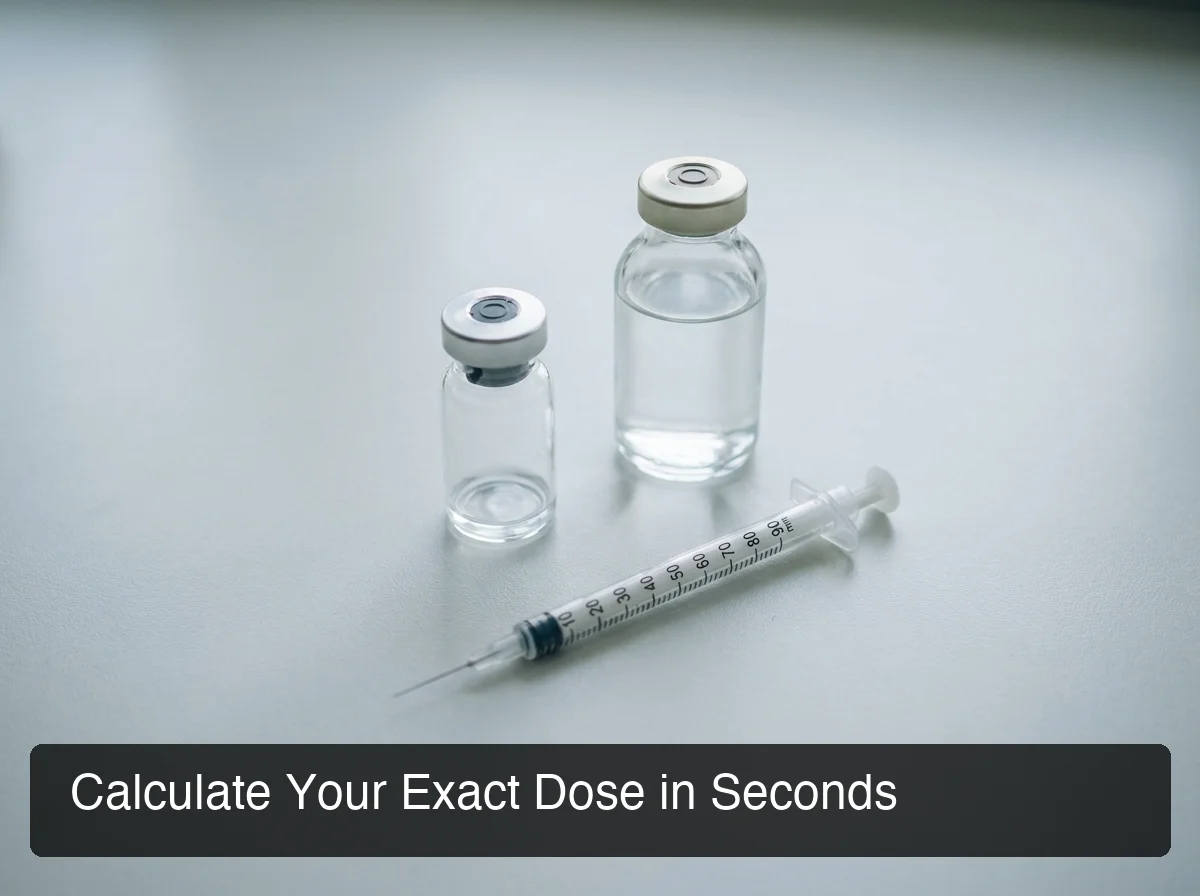 Reconstitution math sets the concentration for the vial's entire run — accurate BAC water measurement is the step that determines every dose that follows.
PeptideIQ's reconstitution calculator handles this automatically. You input the peptide amount in the vial (mg), the BAC water volume (ml), and your target dose (mcg) — the app returns the exact syringe units to draw, with a visual syringe illustration showing precisely where the line falls.
Syringe type (U-100, U-50, or U-30) toggles dynamically and updates the unit output accordingly. All values save to the vial's inventory record automatically.
For the full reconstitution procedure — needle insertion technique, mixing method, storage after mixing — the BPC-157 reconstitution step-by-step guide covers the procedural detail. For a unified dose reference across both peptides and others in common stacks, the peptide dosage cheat sheet has the combined BPC-157 + TB-500 numbers in one lookup table.
How Long Should You Run a BPC-157 + TB-500 Protocol?
The standard BPC-157 + TB-500 protocol runs 6–8 weeks, with a 4–6 week off period before restarting. The structure: 2 weeks of loading at full frequency for both peptides, followed by a 4–6 week sustained phase where BPC-157 continues twice daily and TB-500 drops to once weekly.
Both peptides work through cumulative tissue mechanisms. BPC-157 upregulates growth factors in tendon and connective tissue repair; TB-500's active fragment modulates cell migration and reduces local inflammation. Neither effect peaks by week 2.
Most users who observe meaningful improvement report it between weeks 3 and 6. For a breakdown of expected results by week and how to assess whether a follow-up cycle is warranted, the BPC-157 + TB-500 stack guide covers the full arc.
Can You Adjust Your BPC-157 TB-500 Dosage If Results Aren't Showing?
If no meaningful change in pain, mobility, or recovery metrics appears by week 3–4, examine adherence before changing dose. If adherence is confirmed, increase BPC-157 from 200 mcg to 250–300 mcg twice daily and verify you're using the full loading dose for TB-500 (1,000 mcg/week across two injections) before concluding the stack isn't working.
Missing 3–4 doses per week is not an 8-week protocol — it's an underdosed one. That's the most common reason users at week 4 conclude the stack "isn't working" when the real variable is inconsistent delivery.
Common mistake: Rotating injection sites daily but staying in the same anatomical region — only the upper abdomen, for example. True rotation cycles across all available areas. Localized absorption resistance from partial rotation can mimic under-dosing and lead to unnecessary dose increases.
If adherence is confirmed and results remain flat at week 5, consider injecting BPC-157 slightly closer to the primary injury site within your existing rotation. Localized delivery near the target tissue is one of BPC-157's documented mechanisms.
What Happens If You Dose Your BPC-157 + TB-500 Stack Incorrectly?
Under-dosing from reconstitution errors or missed injections produces no therapeutic effect — not partial effect. Over-dosing raises side effect risk: injection site soreness, mild nausea, temporary lightheadedness post-injection, and occasional flushing. Neither compound has a documented toxicity ceiling at 2–5x standard doses in preclinical research, but side effect frequency increases noticeably above 500 mcg twice daily for BPC-157.
Reality check: Concentration errors during reconstitution are more common than outright injection errors. Adding 1 ml of BAC water instead of 2 ml to a 5mg BPC-157 vial doubles your concentration — and doubles your effective dose at every injection that follows, without any indication that something is wrong.
Timing errors compound over the cycle. Dosing BPC-157 once daily when the protocol calls for twice daily delivers roughly half the therapeutic tissue concentration — a gap that matters across 8 weeks.
Why Does Tracking Your BPC-157 + TB-500 Stack Matter?
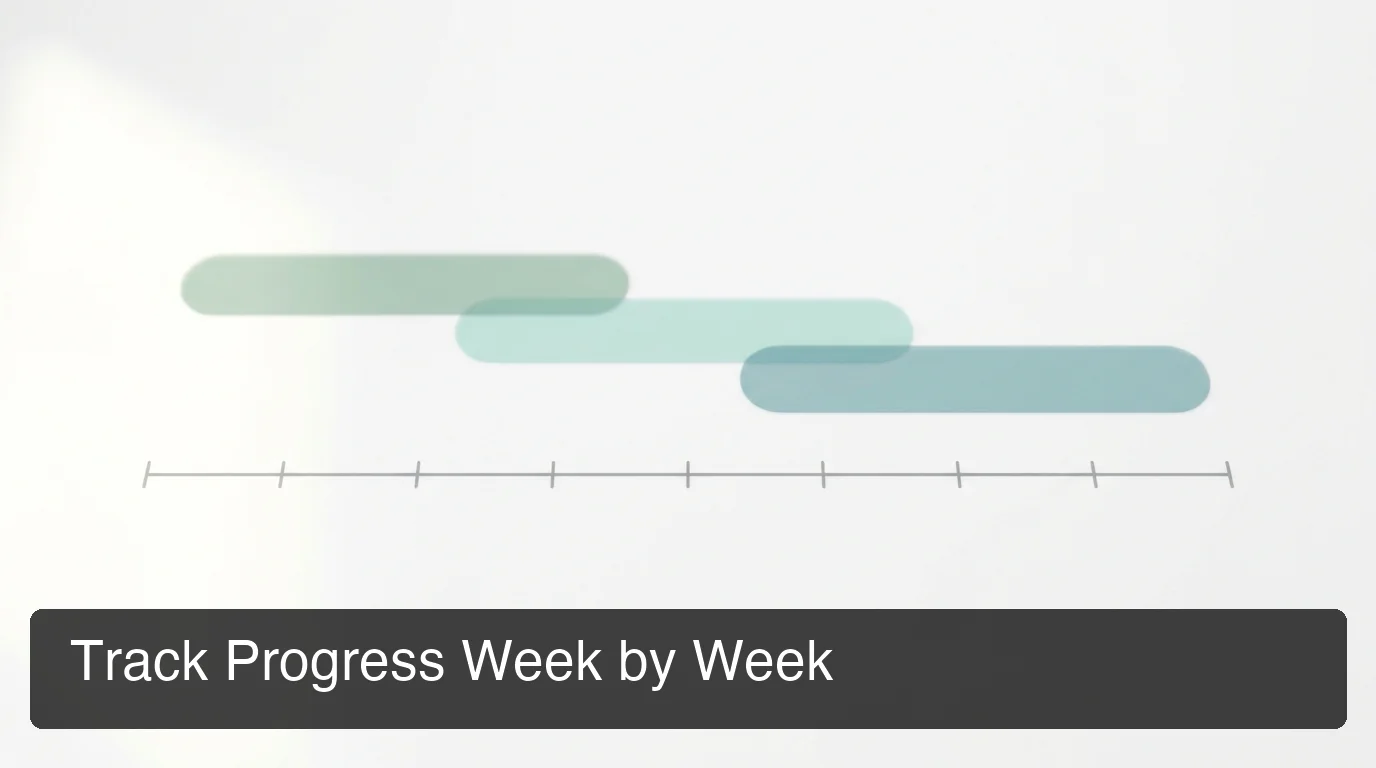 An 8-week BPC-157 + TB-500 protocol has distinct phases — only week-by-week tracking reveals whether the stack is responding as expected.
Pain, mobility, and energy don't shift in dramatic weekly jumps. They move gradually — often below the threshold of daily perception. Users who log weekly check-ins — rating pain at the injury site, range of motion, energy level, and sleep quality — consistently catch improvement between weeks 3 and 5 that they would have attributed to nothing without the data.
Compliance matters just as much. An 8-week protocol at 80% adherence is a 6.4-week protocol in terms of total dose delivered — and the missed doses compound most during the loading phase, when saturation timing is most critical. Tracking reveals adherence gaps in real time, before they've affected the entire cycle.
PeptideIQ logs every dose with site, timing, and wellness check-ins, then generates a weekly AI insight card based on your actual data.
Week 3 might read: "Your pain score dropped from 7.2 to 5.1 — a 30% reduction. BPC-157 protocols show their strongest improvement between weeks 3 and 6. Keep logging." That's your protocol interpreted in context — not generic peptide information.
What this means for you: Guessing whether the stack is working produces the worst outcomes — stopping a protocol that was working, switching peptides unnecessarily, or blaming the vendor. Logged data produces decisions based on actual results.
Get Started with PeptideIQ
Tracking a BPC-157 + TB-500 protocol across 8 weeks — twice-daily BPC-157, weekly TB-500 injections, injection site rotation for both, and reconstitution math across two separate vials — is exactly the problem PeptideIQ was built to solve. The app manages dose logging, site rotation history, reconstitution calculations, and weekly progress insights in one place.
Download PeptideIQ on the App Store
Frequently Asked Questions
Can you inject BPC-157 and TB-500 in the same syringe?
Yes, if both are reconstituted separately and the combined volume stays within a comfortable subcutaneous injection range (0.3–0.5 ml). Draw BPC-157 first, then TB-500 into the same syringe; pre-blended vials from vendors eliminate this step entirely. The tradeoff is losing the ability to adjust each peptide's dose independently.
What BAC water volume should I use for a 5mg BPC-157 vial?
Two milliliters is the standard choice. It produces a 2,500 mcg/ml concentration where each U-100 unit equals exactly 25 mcg — clean math for 250 mcg doses (10 units) and 300 mcg doses (12 units). Less BAC water increases concentration and reduces injection volume; more BAC water does the opposite without changing the peptide amount.
How long does a reconstituted BPC-157 vial last in the refrigerator?
Approximately 28–30 days refrigerated. TB-500 has a similar window once reconstituted. Both degrade faster at room temperature or when exposed to light — PeptideIQ tracks the reconstitution date automatically and alerts you 5 days before the window closes.
Do BPC-157 and TB-500 need to be injected at different times of day?
No — BPC-157's twice-daily schedule and TB-500's 1–2x weekly schedule operate independently of each other. On days when a TB-500 injection overlaps with a BPC-157 dose, you can administer them back-to-back or at different points in the same day. Injection site rotation still applies to each peptide independently.
What is the difference between the TB-500 loading and maintenance phases?
Loading (weeks 1–2) uses twice-weekly injections at 500–1,000 mcg per injection — 1,000–2,000 mcg total per week — to establish systemic TB-500 levels quickly. Maintenance (weeks 3–8) drops to once-weekly injections at the same per-injection dose, sustaining elevated TB-500 activity with less injection frequency. The same peptide amount per injection; different weekly frequency.