
CJC Peptide: Benefits, Dosage & How It Works | PeptideIQ
What Is CJC Peptide? Benefits, Dosage & How It Works
CJC-1295, commonly called the CJC peptide, is a synthetic GHRH analog — a 30-amino-acid compound that signals your pituitary gland to produce more growth hormone. It mirrors what your hypothalamus does naturally, but with a half-life that makes twice-weekly dosing viable where the body's own GHRH clears in under two minutes.
In clinical studies, a single CJC-1295 injection produced 2- to 10-fold increases in mean growth hormone levels with sustained elevation lasting several days.
What Is the CJC Peptide?
CJC-1295 (also labeled Mod GRF 1-29 in its DAC-free form) is a synthetic analog of growth hormone-releasing hormone (GHRH) — the peptide your hypothalamus uses to initiate GH secretion from the pituitary. It binds GHRH receptors in the anterior pituitary, triggering growth hormone release in a pulse pattern that closely mimics normal physiology. Unlike exogenous HGH injections, CJC-1295 stimulates your body's own GH production rather than bypassing it.
Two structural variants exist. CJC-1295 with DAC binds to albumin and extends half-life to roughly 6-8 days. Mod GRF 1-29 (without DAC) has a 30-minute active window and is the version most protocols use on standard 2-3x weekly schedules. If peptides are new to you, the beginner's peptide guide covers the core terminology before you build out a protocol.
PeptideIQ's peptide library catalogs CJC-1295 with its evidence level designation — Strong Animal Evidence plus Early Human Trials — alongside its mechanism classification and recommended beginner starting dose. That evidence grade matters: CJC-1295 is more research-supported than most gray-market peptides, but it is not FDA-approved. The library is explicit about that distinction, which is the reference you'll access in-app when building your protocol.
 CJC-1295 stimulates growth hormone through natural pituitary signaling — not synthetic HGH replacement.
Key Takeaways
- CJC-1295 is a synthetic GHRH analog with a 30+ minute half-life (Mod GRF 1-29) or 6-8 day half-life (with DAC), making twice-weekly dosing viable where natural GHRH clears in under two minutes.
- Most serious users stack CJC-1295 with ipamorelin (a GHRP) to amplify GH pulses synergistically; the combination produces GH responses 3-5x stronger than either compound alone.
- Beginner protocol: 100-200 mcg per injection, 2-3x weekly, in a fasted state, for 8-16 weeks.
- Common side effects — water retention, mild paresthesia, appetite changes — peak in weeks 2-3 and typically resolve without intervention.
- PeptideIQ's half-life visualizer shows your accumulated CJC-1295 level between doses so you know exactly where you are before your next injection.
Contents
- What Is the CJC Peptide?
- How Does CJC-1295 Work in Your Body?
- What Are the Benefits of CJC-1295 for Muscle Growth and Recovery?
- What Should You Stack with CJC-1295?
- What's a Normal CJC-1295 Dosage and Schedule?
- How Long Does CJC-1295 Stay in Your System?
- Is CJC-1295 Safe for Long-Term Use?
- Track Your CJC Peptide Protocol
How Does CJC-1295 Work in Your Body?
CJC-1295 binds to GHRH receptors in the anterior pituitary, triggering a GH pulse into circulation. That GH then stimulates the liver to produce IGF-1 (insulin-like growth factor 1), which drives the downstream benefits: muscle protein synthesis, fat oxidation, bone density, and tissue repair. The entire mechanism operates through your own GH axis — CJC-1295 initiates the signal, your body does the rest.
Timing determines outcome. Natural GH release peaks during deep sleep; administering CJC-1295 30-60 minutes before bed amplifies that window. Fasted administration is non-optional — food-driven insulin spikes suppress GH release and substantially blunt the response.
Worth knowing: CJC-1295 is often confused with sermorelin, another GHRH analog. Sermorelin has a 12-minute half-life. CJC-1295 (Mod GRF 1-29) has a 30+ minute half-life. That difference is what makes twice-weekly dosing viable for CJC-1295 while sermorelin typically requires daily injections.
What Are the Benefits of CJC-1295 for Muscle Growth and Recovery?
CJC-1295 raises IGF-1, which supports muscle protein synthesis, faster recovery between training sessions, deeper slow-wave sleep, and gradual body composition improvement — specifically increased lean mass and reduced fat, particularly visceral fat. Multiple human studies document these effects, with body composition changes becoming meaningful after 8-12 weeks of consistent use.
The benefits break down by goal:
- Muscle and performance: Elevated IGF-1 directly increases protein synthesis rates and shortens recovery windows between sessions
- Fat loss: IGF-1 promotes fat oxidation, with visceral fat reduction the most consistently documented outcome. The CJC-1295 weight loss protocol guide covers caloric context and cycle timing for fat-loss-specific use
- Sleep quality: GH elevation during slow-wave sleep improves sleep architecture and recovery depth
- Anti-aging: Higher IGF-1 supports collagen synthesis and bone mineral density over longer cycles
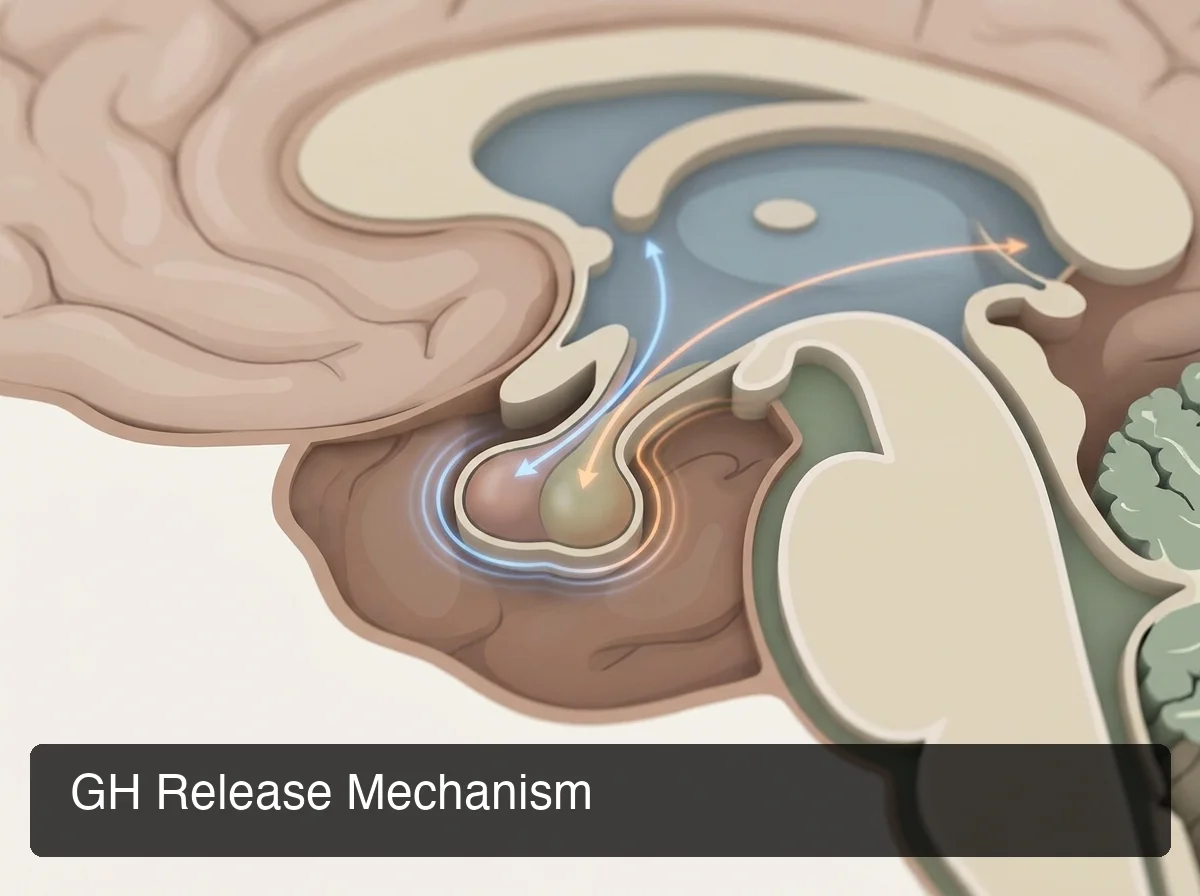 CJC-1295 works through GHRH receptors — GH release triggers IGF-1 production in the liver, driving downstream benefits.
What Should You Stack with CJC-1295?
The standard combination is CJC-1295 + ipamorelin. Ipamorelin is a GHRP (growth hormone-releasing peptide) that amplifies GH pulses by blocking somatostatin — the hormone that naturally suppresses GH release. CJC-1295 initiates the GH pulse; ipamorelin deepens it. Together, they produce GH responses roughly 3-5 times stronger than either compound alone.
| CJC-1295 | Ipamorelin | |
|---|---|---|
| Class | GHRH analog | GHRP (ghrelin mimetic) |
| Mechanism | Stimulates GH via GHRH receptor | Amplifies GH pulse, blocks somatostatin |
| Half-life | 30 min (no DAC) / ~6-8 days (DAC) | ~2 hours |
| Solo effectiveness | Moderate GH elevation | Effective but weaker GH pulse |
| Stacked | Initiates the pulse | Deepens and amplifies it |
The CJC-1295 + ipamorelin combination is what most longevity clinics and experienced protocol users run. The two are typically injected simultaneously at the same site. For complete stack setup — dosing ratios, injection timing, phase transitions, and cycle structure — the CJC-1295 peptide therapy protocol guide covers the full workflow.
What's a Normal CJC-1295 Dosage and Schedule?
Beginner CJC-1295 protocol: 100-200 mcg per injection, 2-3 times weekly, fasted, 30-60 minutes before sleep or training. Cycle length: 8-16 weeks. Intermediate and advanced users scale to 250-500 mcg at 3-5x weekly. Injection timing in a fasting window is non-negotiable — eating within 2 hours before injection reduces the GH response significantly.
| Experience Level | Dose per Injection | Frequency | Cycle Length |
|---|---|---|---|
| Beginner | 100–200 mcg | 2-3x weekly | 8–12 weeks |
| Intermediate | 250–300 mcg | 3x weekly | 12–16 weeks |
| Advanced | 300–500 mcg | 3-5x weekly | 16–24 weeks |
Dose calculation from your specific vial concentration can be done with the peptide dosing calculator — input vial size in mg, BAC water volume, and target dose to get exact syringe draw units.
PeptideIQ's Cycle Planner auto-enables the fasting window timer for CJC-1295 at protocol setup. It fires a pre-injection notification 30 minutes before your scheduled time, confirming you're in the correct fasting window before you draw.
 Consistent dosing timing — not just total dose — determines whether CJC-1295 delivers results across a cycle.
How Long Does CJC-1295 Stay in Your System?
Mod GRF 1-29 (without DAC) clears in roughly 30-60 minutes, but the GH pulse it triggers elevates circulating GH for 6-8 hours and raises IGF-1 for several days afterward. CJC-1295 with DAC binds to albumin and remains pharmacologically active for 6-8 days per injection — making once-weekly or bi-weekly dosing viable for the DAC version.
Downstream IGF-1 elevation persists for 3-5 days after a Mod GRF 1-29 injection. Twice-weekly dosing maintains near-continuous IGF-1 elevation across the cycle, which is why adherence matters more than any single injection.
PeptideIQ's half-life visualizer plots your accumulated active CJC-1295 level across overlapping doses. Instead of guessing whether last week's injection is still active, you see a curve showing estimated compound still in your system before your next scheduled dose. For DAC users, this is particularly relevant — injecting on an already-elevated baseline changes the effective cumulative dose.
Is CJC-1295 Safe for Long-Term Use?
CJC-1295 has a well-characterized safety profile at research dosages. The most common effects — water retention, mild paresthesia, and appetite changes — are transient, typically peaking in weeks 2-3 and resolving without intervention. Long-term safety beyond 6 months remains understudied, and CJC-1295 is not FDA-approved, so no standardized clinical monitoring protocol exists for unsupervised use.
Side effects reported across protocols:
- Water retention (most common; weeks 1-4)
- Injection site redness or mild swelling
- Tingling or numbness in hands and feet (paresthesia)
- Appetite increase
- Transient fatigue in the adaptation window (weeks 1-2)
Common mistake: Abandoning the protocol at weeks 2-3 when water retention peaks, assuming the compound isn't working. That retention is the most predictable transient effect — it resolves. The CJC-1295 side effects guide covers the full timeline of what to expect and when each effect typically clears.
Bloodwork monitoring — specifically IGF-1 levels at baseline and mid-cycle — is the most reliable way to confirm your protocol is producing the intended physiological response. Without it, you're dosing blind.
Track Your CJC Peptide Protocol
Consistent dosing timing and fasting compliance determine whether CJC-1295 delivers. Most protocol failures trace to missed injections, incorrect fasting windows, or no baseline bloodwork to confirm IGF-1 is actually rising.
PeptideIQ is built for exactly this use case. The half-life visualizer, fasting window timer, injection site rotation guide, and bloodwork tracker for IGF-1 trends are all designed around CJC-1295 and similar growth hormone protocols. The AI co-pilot loads your cycle context — ask it protocol questions and get answers grounded in your specific dose history.
Download PeptideIQ on the App Store
Frequently Asked Questions
What does CJC peptide do?
CJC-1295 signals the pituitary gland to release growth hormone by mimicking GHRH, the body's natural GH trigger. It raises IGF-1 — the downstream driver of muscle protein synthesis, fat oxidation, tissue repair, and sleep quality. Effects build progressively over 4-8 weeks and compound meaningfully across a full 8-16 week cycle.
Does CJC-1295 raise testosterone levels?
CJC-1295 does not directly affect testosterone. It operates through the GH/IGF-1 axis, not the HPG axis that governs testosterone production. Energy and body composition improvements some users attribute to testosterone are driven by IGF-1 — a meaningfully different hormonal pathway that bloodwork can distinguish.
What is the best peptide to stack with CJC-1295?
Ipamorelin is the standard CJC-1295 stack partner. A GHRP that amplifies GH pulses by blocking somatostatin, ipamorelin combines with CJC-1295 to produce GH responses 3-5 times stronger than either alone. The two are typically injected simultaneously at the same time and site, making the stack as logistically simple as running either compound solo.
How long does CJC-1295 take to work?
Most users notice improved sleep quality and recovery within 2-4 weeks. Visible body composition changes — increased lean mass, reduced body fat — typically require 8-12 weeks of consistent dosing. IGF-1 blood levels begin rising within the first two weeks, which periodic bloodwork can confirm without waiting for visual changes.