
PeptideIQ Accuracy: Three-Layer Tracking Explained
PeptideIQ Accuracy: Why Context Beats a Perfect Dose Log
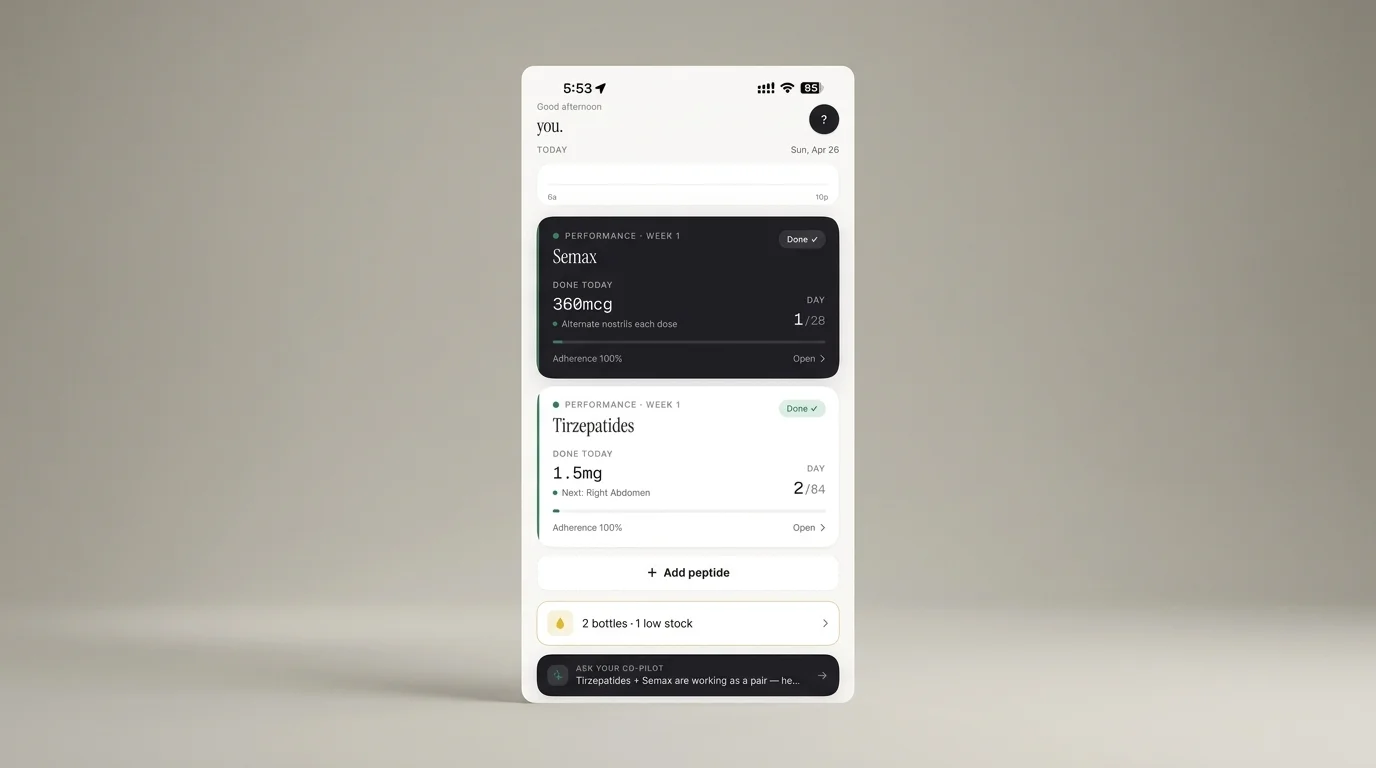
Two protocols sit on the PeptideIQ Today screen right now: Semax at 360mcg, day 1 of a 28-day cycle, and tirzepatide at 1.5mg, day 2 of an 84-day cycle. Both read "Adherence 100%." But peptideiq accuracy was never really about that number — it's about what happens on day 40, when a small deviation is easy to miss and hard to explain without the context a plain dose log doesn't capture.
What Does PeptideIQ Accuracy Actually Mean for a Peptide Tracking App?
PeptideIQ accuracy means three connected things working together: a correctly logged dose, a correctly calculated metric derived from that dose, and an AI-generated interpretation that explains what the number means for this specific protocol. Most tracking apps stop at the first layer. A checkmark next to "dose taken" tells you almost nothing about whether the protocol is actually working.
Precision matters most at the math layer first. Reconstitution — mixing freeze-dried peptide powder with bacteriostatic water — is where a lot of tracking errors start, long before a dose ever gets logged. Get the concentration wrong and every "accurate" log afterward is accurately wrong.
That's a separate problem from adherence tracking, and it's worth understanding on its own. Readers working through the math by hand should see which peptide calculator app is best for beginners before trusting any dose log downstream of it.
PeptideIQ Accuracy Runs on Three Layers, Not One Number
The first layer is the raw input: what the user actually logged, when, and at what dose. The second layer is calculated metrics built from that input — adherence percentage, active concentration decay, vials remaining. The third layer is AI-contextual analysis that reads those metrics against the user's specific cycle phase, wellness sliders, and side effect history.
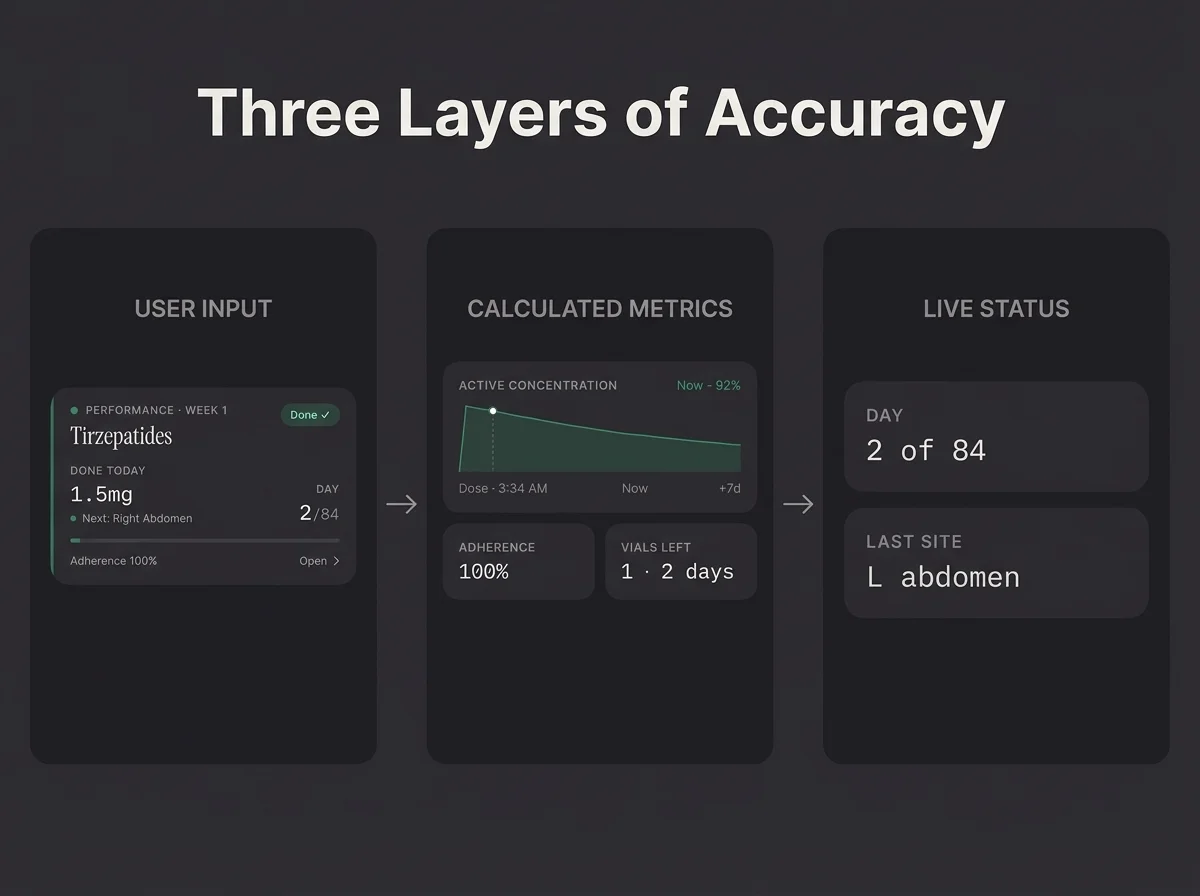 Raw input flows into calculated metrics, then into the live status a user actually checks.
Here's why the separation matters. A user can log every dose perfectly and still be running an ineffective protocol — wrong site, wrong timing, unaddressed side effects.
Layer one alone would show a spotless streak. Layers two and three are what catch the problem.
Concurrent protocol tracking extends this same logic to stacks. Someone running CJC-1295 and Ipamorelin together needs adherence, concentration curves, and site rotation calculated per peptide, not blended into a single misleading average.
Injection Site Rotation Is Part of the Accuracy Picture
A dose log that ignores injection site isn't tracking the full picture. PeptideIQ's site rotation diagram uses a color-coded body map — green for a site that's ready, yellow for one used in the last 48 hours, red for one used today — and recommends the next site automatically based on that history.
Site-specific irritation is a real, trackable pattern. A user injecting the same spot repeatedly can develop localized soreness or reduced absorption, and neither shows up in a simple "dose logged" checkmark. It shows up when site history is cross-referenced against side effect tags.
Worth knowing: Side effects in PeptideIQ are logged with severity — Mild, Moderate, or Severe — against a specific symptom like injection site soreness, so a pattern tied to one site is visible within days, not months.
Last-site tracking also feeds the adherence calculation indirectly. If a protocol calls for rotation and the same site keeps showing up as "last used," that's a data point the AI co-pilot can flag before it becomes a bigger problem.
Raw Dose Logs Miss What Context Catches
A generic dose logger and a layered tracking system can show identical adherence percentages while telling completely different stories. The number alone doesn't say whether a protocol is working, whether a side effect pattern is emerging, or whether a dose needs adjustment.
| What's tracked | Generic dose logger | PeptideIQ |
|---|---|---|
| Dose taken vs. missed | Yes | Yes |
| Injection site rotation | No | Yes — color-coded, auto-recommended |
| Active concentration decay | No | Yes — real-time curve per peptide |
| Wellness context (energy, mood, sleep) | No | Yes — quick sliders logged per dose |
| Side effect severity tagging | No | Yes — Mild/Moderate/Severe per symptom |
| AI interpretation of the pattern | No | Yes — weekly insight cards |
A PeptideIQ review walks through this feature set end to end; the short version is that raw counts are the easy part. Interpreting them against a specific protocol phase is the part most tools skip entirely.
Why Does Accuracy Matter in Peptide Tracking?
Accuracy matters most when it prevents a costly mistake — a missed dose, a concentration error, a dangerous stacking interaction, or a reused injection site causing inflammation. These aren't abstract risks. They're the specific failure modes that happen when tracking is a spreadsheet nobody reviews until something feels wrong.
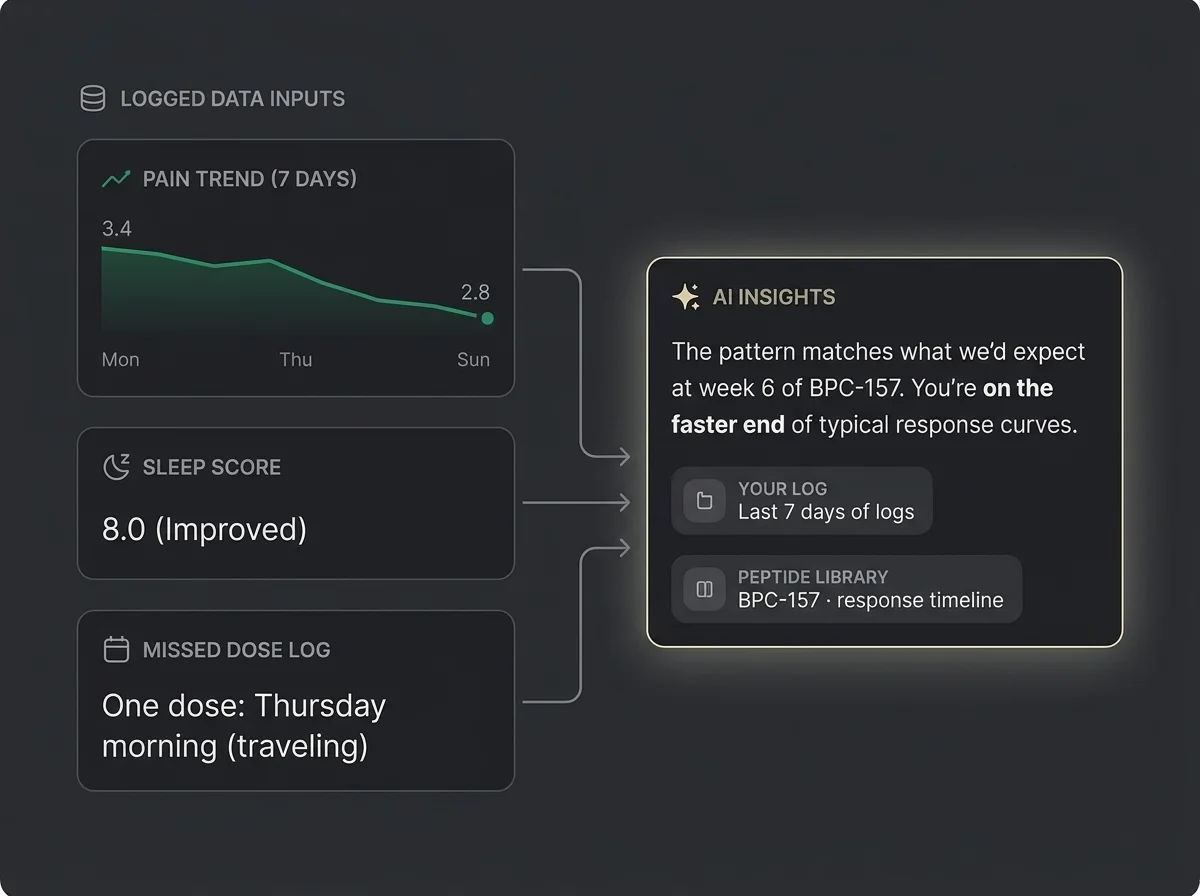 Logged data becomes an explanation, not just a chart.
This is the moment where layered accuracy becomes a real advantage over generic logging. A raw log shows "pain score: 2.8."
An AI-contextual read shows a 7-day pain trend dropping from 3.4 to 2.8 — an 18% improvement — alongside a missed dose on a travel day, and a note that the trajectory matches what's typical at week 6 of a BPC-157 protocol. One of those tells a user what to do next.
That's a different value proposition than what PeptideIQ offers on the surface as "a tracking app." The tracking is table stakes. The interpretation is the product.
The AI Co-Pilot Turns Logged Data Into Explanation
Every AI co-pilot conversation in PeptideIQ starts with a context payload: active protocols, current cycle day, the last seven days of wellness logs, any logged side effects, bloodwork on file, and the user's stated goal. That context is what separates an answer grounded in this specific protocol from generic peptide advice available anywhere.
Weekly AI insight cards apply the same logic on a schedule instead of on request. Every Monday, a new card generates from that week's actual data — not a templated tip, a summary built from what was actually logged.
- Adherence rate for the week, calculated per protocol
- Primary goal metric trend (pain, weight, recovery score, or vitality depending on the user)
- Side effects flagged, with severity
- A plain-language note on whether the pattern fits the expected timeline for that peptide
This is where PeptideIQ's approach differs from peptideiq alternatives that log the same raw numbers without the weekly synthesis step.
Real-Time Feedback Catches Problems Before They Compound
Retrospective tracking has a built-in lag problem. A user who only reviews their data at the end of a three-month cycle finds out a protocol wasn't working after most of the cycle is already gone. Real-time feedback closes that loop while there's still time to course-correct.
An app that tracks your data in real time and surfaces a pattern within days — not months — is the difference between adjusting a dose mid-cycle and discovering the issue in hindsight. That immediacy is also what makes a dashboard that shows progress week by week more useful than a static end-of-cycle summary.
Low-stock and expiry alerts work on the same real-time principle. A notification fires when fewer than seven days of doses remain, and again five days before a vial expires — regardless of how much is left in the fridge. Neither depends on the user remembering to check.
Quick Recap
Quick Recap
- PeptideIQ accuracy is a three-layer system: logged dose, calculated metrics, and AI-contextual interpretation — not a single adherence percentage.
- Injection site rotation, tracked with color-coded history, catches site-specific irritation that a plain dose log can't see.
- Weekly AI insight cards explain why a pattern matters for a specific protocol phase, built from actual logged data each Monday.
- Real-time feedback lets users adjust mid-cycle instead of finding out a protocol wasn't working three months later.
- Concurrent protocol tracking keeps accuracy calculations separate per peptide for anyone running a stack.
Get Started with PeptideIQ
Accuracy only matters if it changes what a user does next — logging a dose is the easy part, understanding it is the point. PeptideIQ builds that interpretation layer into the protocol tracking itself, from site rotation to weekly AI insights.
FAQ
How does PeptideIQ calculate adherence percentage?
Adherence is calculated per protocol by comparing doses logged against doses scheduled for that specific peptide's cycle. For stacks, each peptide gets its own adherence figure rather than one blended average, so a missed dose on one protocol doesn't distort the picture for another.
Does PeptideIQ track injection site rotation automatically?
Yes. A color-coded body diagram marks sites green (ready), yellow (used in the last 48 hours), or red (used today), and PeptideIQ recommends the next site based on that rotation history — reducing the chance of reusing a site too soon.
Can PeptideIQ catch dosing errors before they become problems?
PeptideIQ surfaces patterns — like three consecutive low-energy check-ins or a site used too frequently — through automatic prompts and weekly AI insight cards. It flags what's worth a closer look based on logged data; it doesn't replace clinical judgment for anything urgent.
How accurate are PeptideIQ's reconstitution and dose calculations?
The reconstitution calculator computes concentration directly from vial amount, water volume, and target dose, then shows the exact syringe unit to draw. A reverse calculator works the other direction — enter target units, get the required water volume — for users starting from a syringe reading.
Is PeptideIQ's AI co-pilot just a generic chatbot with peptide knowledge?
No. Every conversation initializes with the user's active protocols, current cycle day, recent wellness logs, and side effect history, so answers are grounded in that specific situation rather than generic peptide information available anywhere else.