
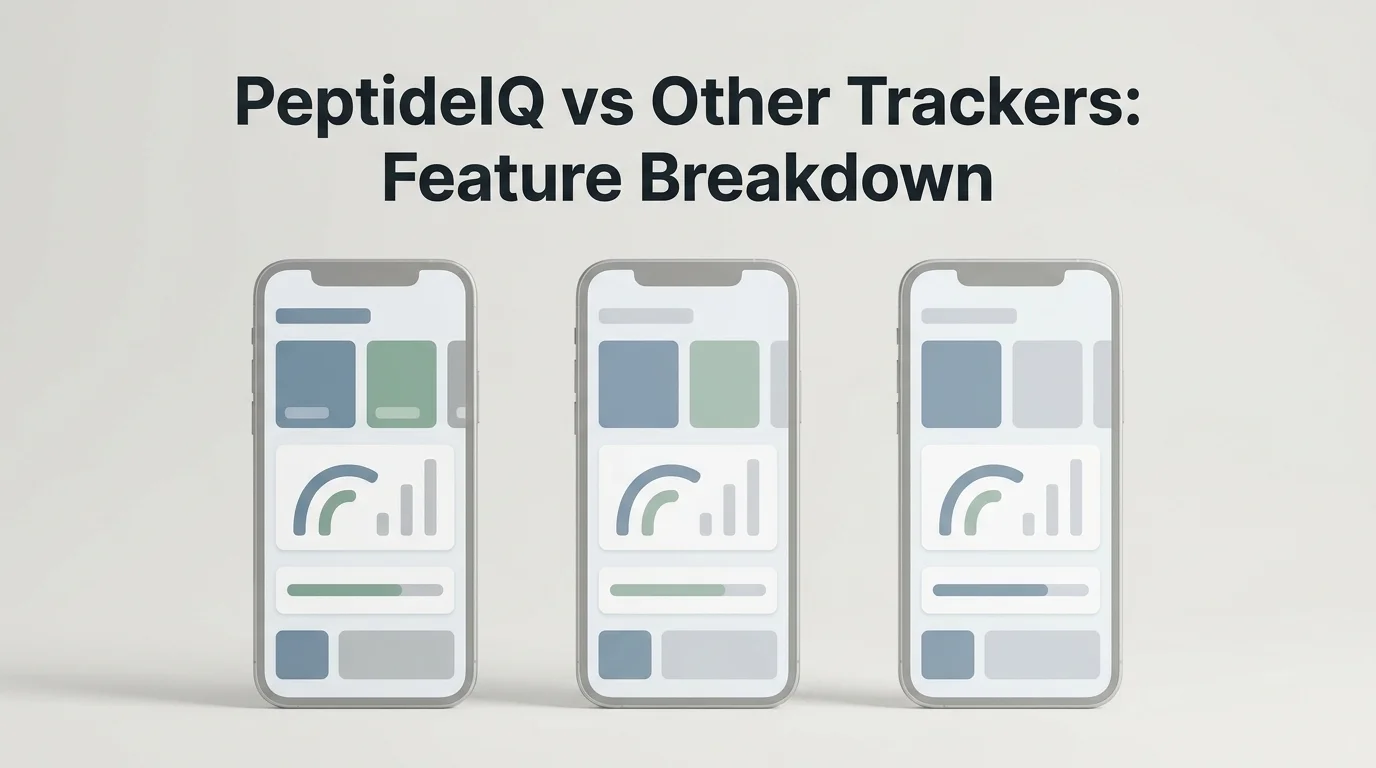
PeptideIQ Alternatives 2026: Full Feature Comparison
PeptideIQ Alternatives in 2026: How the Feature Set Actually Compares
Four kinds of tools show up when someone searches for a peptide tracker: generic health loggers, bare-bones dose loggers, a spreadsheet someone built in an afternoon, and a chatbot that forgets your protocol the moment you close the tab. Only one of those carries context between sessions.
We ran a feature audit against the tools people most often compare when searching peptideiq alternatives, and the gap wasn't close — none of them combine a half-life visualizer, a fasting window timer, and bloodwork tracking in one app. Here's what each category actually offers, where it falls short, and where PeptideIQ was built to close that gap.
Key Takeaways
- PeptideIQ's AI co-pilot initializes with a user's active protocol, cycle day, and logged wellness data — most alternatives are dumb loggers that record numbers without interpreting them.
- The feature gap is specific: Half-Life Visualizer, Active Concentration tracking, Fasting Window Timer, Bloodwork Tracking, and Injection Site Rotation appear in PeptideIQ and are missing from most competing apps.
- PeptideIQ builds the process, not just the log — it walks users through protocol setup, dose escalation phases, and adjustment decisions instead of leaving them to figure it out alone.
- Beginners get a reconstitution calculator and visual syringe guide that remove injection anxiety; experienced multi-peptide users get stack management and correlation analytics.
- Real alternatives exist — generic health apps, dumb peptide loggers, Reddit spreadsheets — but none combine AI context, protocol intelligence, and simple tracking in a single app.
What Makes PeptideIQ Different From Other Peptide Tracking Apps?
PeptideIQ's AI co-pilot is initialized with a user's active protocol, cycle day, wellness logs, and bloodwork before it answers a single question — a structural difference from apps that log data without interpreting it. That context is the entire product thesis: the process is the product, and the AI is the co-pilot, not a bolted-on chat window.
The clearest way to see the gap is side by side. Here's how what PeptideIQ actually tracks stacks up against the categories people compare it to:
| Feature | PeptideIQ | Generic Health Loggers | Dumb Peptide Loggers | Reddit / Spreadsheets | Generic AI Chatbot |
|---|---|---|---|---|---|
| Knows your specific protocol & cycle | Yes | No | No | No | No — resets each chat |
| Half-Life / Active Concentration Visualizer | Yes | No | No | No | No |
| Reconstitution Calculator | Yes | No | Rare | Manual math | No |
| Fasting Window Timer | Yes | No | No | No | No |
| Bloodwork tracking with AI correlation | Yes | Partial, no peptide context | No | Manual | No |
| Injection site rotation guide | Yes | No | Rare | No | No |
By the numbers: Across the six rows above, PeptideIQ was the only tool that scored a "yes" on every one — the rest ranged from zero to two out of six.
How Does PeptideIQ's AI Co-Pilot Compare to Generic Peptide Loggers?
A generic peptide logger records what a user types and nothing more; PeptideIQ's AI co-pilot pulls in the last seven days of wellness logs, current cycle day, side effects, and bloodwork before it responds, so an answer about fatigue or dosing is grounded in that specific user's data. Ask a dumb logger a question and there's nowhere to send it — most don't have a chat layer at all.
Ask a generic AI chatbot the same question and it can explain a peptide's mechanism in general terms, but it has no memory of what cycle day someone's on or what they logged yesterday. Every conversation starts from zero.
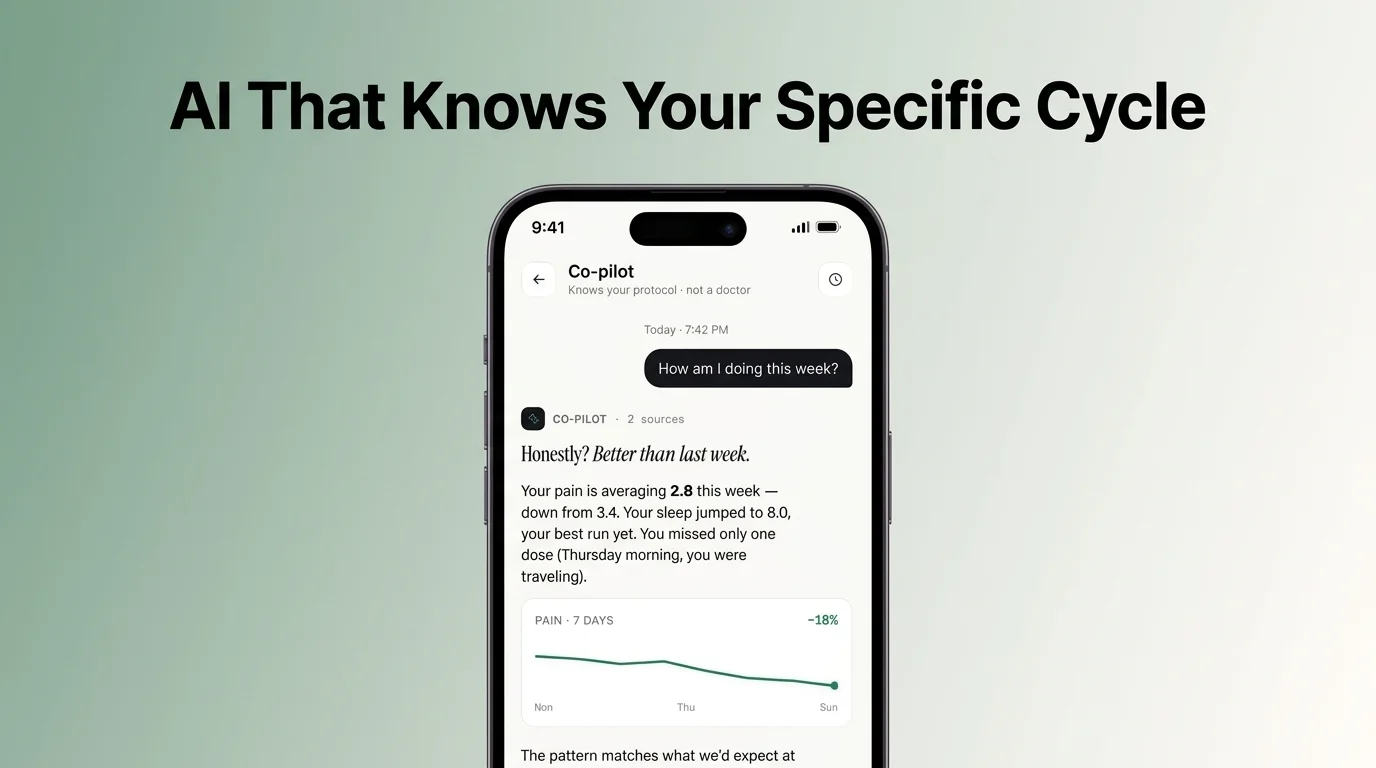 The co-pilot referencing an actual pain trend and adherence pattern instead of giving a generic answer.
PeptideIQ's weekly AI insight cards run the opposite way — the system already knows a user is six days into a cycle with pain scores trending down and one missed dose from travel, so the summary reads like a note from someone who's been watching, not a lookup.
Does PeptideIQ Actually Help You Track Protocols Better Than Competitors?
Tracking that goes beyond a checkbox is what separates PeptideIQ from a basic log — Protocol Hub shows adherence percentage, current cycle day, and next dose in one glance, while most competing apps only confirm that a dose was entered. A PeptideIQ review of the app's core screens shows the same pattern across every feature: structure first, logging second.
Dumb loggers ask "did you take it?" PeptideIQ asks that too, then layers dose escalation phase tracking, injection site rotation, and inventory alerts on top. A missed dose, a low vial, and an expiring batch all surface automatically instead of getting discovered too late.
Worth knowing: Injection site rotation alone solves a problem most loggers don't track at all — repeated injection in the same spot without a visual reminder is one of the more common self-reported frustrations in peptide communities.
Which PeptideIQ Alternatives Handle Multi-Peptide Stacks Best?
For anyone running more than one peptide at once — a growth hormone stack plus BPC-157, for example — PeptideIQ is built around multi-protocol cards with an Active Concentration curve running per peptide, a feature that doesn't exist in single-entry dose loggers or spreadsheets. Most alternatives treat each peptide as an isolated log line with no view of how the doses overlap.
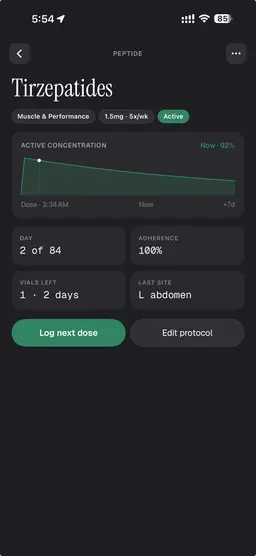 The active concentration curve for a single protocol, showing how much of the last dose is still in the system.
That curve matters most for peptides with longer half-lives, where a new dose stacks on top of what's still active from the last one. Seeing that overlap instead of guessing at it is what separates an app built for serious multi-peptide users from one built for a single beginner protocol.
Can PeptideIQ Replace Reddit Spreadsheets and Notes App Tracking?
Yes, for anyone willing to move off a manual system — PeptideIQ replaces row-by-row spreadsheet entry with structured protocol cards, auto-calculated concentration, and an adherence percentage that updates itself instead of requiring a formula. A spreadsheet doesn't forget, but it also doesn't notice a pattern unless someone builds a chart for it.
The best peptide tracker roundup covers why most Reddit-built systems break down after a few months — they capture data but rarely get reviewed, and nobody goes back to eyeball trend lines on a Tuesday night. PeptideIQ's weekly AI insight cards do that review automatically, every week, without anyone opening a formula bar.
How Do PeptideIQ Alternatives Compare on Cost?
PeptideIQ is pre-launch with a freemium model planned — core protocol tracking free, AI co-pilot and advanced analytics on subscription — while generic health apps often charge for tiers that still don't cover peptide protocols, and dumb loggers are typically free but offer nothing past data entry. Reddit and spreadsheets cost nothing but time, and that time adds up fast once a stack gets complicated.
Reality check: Free isn't the differentiator in this category — almost every alternative is free or cheap. The differentiator is whether the free tier actually understands a peptide protocol, and right now most don't.
Readers asking is PeptideIQ free usually want to know if core tracking stays accessible without a subscription — it does, with AI features layered on top for users who want deeper analysis. Compare that to a GLP-1 tracking app built only for semaglutide users, and PeptideIQ's broader peptide library becomes the differentiator once someone runs more than one compound.
Why Choose PeptideIQ?
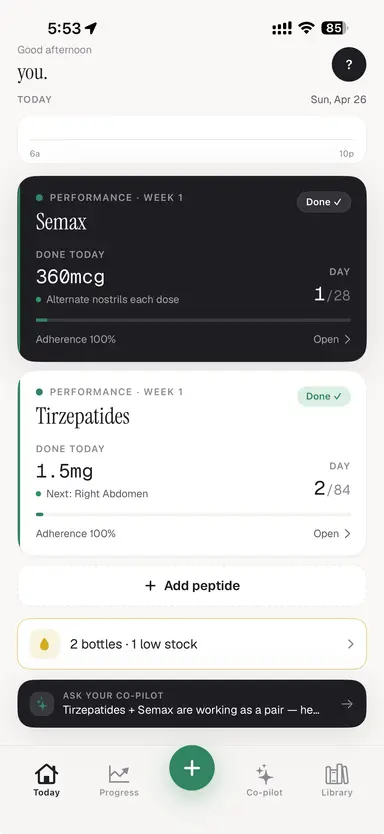 Protocol Hub — the home screen showing active protocols, adherence, and the co-pilot entry point in one view.
Every alternative on this list asks the user to do the thinking — PeptideIQ was built to do more of that thinking with them. Someone staring at a vial in their fridge with no idea what BAC water is needs a system that walks them through a first injection. Someone three peptides into a stack with two years of chaotic notes needs pattern visibility and intelligence, not another blank log.
That's the actual decision behind comparing peptideiq alternatives: pick a tool that stores numbers, or one that understands them. Whether someone's on day one or two years in, that's the gap PeptideIQ was built to close — and it's worth reading up on peptideiq for beginners if the "how do I even start" question is the one holding you back.
Get Started with PeptideIQ
Every alternative on this list can log a dose. Only PeptideIQ turns that log into a system that already knows your protocol, your cycle, and your data before you ask it a question.
Frequently Asked Questions
Is there a free alternative to PeptideIQ?
Generic health loggers and basic peptide dose trackers are free but don't offer protocol intelligence, half-life visualization, or AI context. PeptideIQ's own core tracking — Protocol Hub, dose logging, reconstitution calculator — is also planned to stay free, with the AI co-pilot and advanced analytics as the paid layer.
What's the best PeptideIQ alternative for tracking multiple peptides?
Among current alternatives, dedicated peptide-specific loggers handle multi-peptide entry better than generic health apps, but none visualize overlapping active concentration curves the way PeptideIQ does. Spreadsheet users get the most flexibility but lose the automatic overlap tracking that matters once doses start stacking.
Can I just use ChatGPT instead of a peptide tracking app?
ChatGPT can answer general peptide questions but has no memory of a user's specific cycle day, dose history, or logged side effects between conversations. PeptideIQ's AI co-pilot is initialized with that context every time, which is the functional difference between general knowledge and personalized guidance.
Is PeptideIQ available on Android?
Not yet — PeptideIQ launched iOS-first on iPhone, with Android support planned for Phase 2 after the initial release. There's no confirmed Android date yet, so Android users interested in trying it should join the waitlist to get notified when that rolls out.