
Weight Loss Peptides: Evidence & Cost | PeptideIQ
Weight Loss Peptides: What Works, What It Costs, and What to Expect
Weight loss peptides are protein-based compounds that alter how your body regulates hunger, insulin response, and fat metabolism. The FDA-approved class — GLP-1 agonists like semaglutide and tirzepatide — reduce average body weight by 15–22% over 68-week clinical trials. Nothing in the non-surgical weight loss space has equivalent data.
Knowing which peptides have real evidence, what side effects to actually expect, and how long you need to commit is what separates a protocol that delivers results from one that stalls out after six weeks.
What Are Weight Loss Peptides and Do They Actually Work?
Weight loss peptides are compounds that influence the hormonal signals governing appetite, gastric emptying, and fat metabolism. FDA-approved GLP-1 agonists — semaglutide (Ozempic/Wegovy) and tirzepatide (Mounjaro/Zepbound) — have demonstrated 15–22% body weight reduction in large-scale randomized controlled trials. Other peptides like AOD-9604 and CJC-1295 show supporting effects in animal models, but lack equivalent human evidence.
The GLP-1 mechanism is pharmacologically specific: these peptides bind to receptors in the brain and gut, reducing caloric intake by 20–30% without requiring the user to consciously restrict food. That's why clinical trial participants consistently outperform traditional diet interventions — not through discipline, but because hunger signaling is biochemically lower.
Understanding what a peptide actually is matters here, because "weight loss peptide" spans a wide range. Semaglutide is a weekly injection with a decade of RCT data; AOD-9604 is a truncated GH fragment with early-stage human data. They are not interchangeable.
Gray-market options have plausible mechanisms and some animal data — but anyone claiming clinical equivalence to GLP-1s is extrapolating beyond what the evidence supports.
 FDA-approved GLP-1 peptides sit at a different evidence tier from gray-market alternatives — a distinction that matters when you have a specific timeline.
Key Takeaways
- Semaglutide and tirzepatide are FDA-approved GLP-1 peptides proven to produce 15–22% weight loss in clinical trials — the highest evidence tier for any non-surgical intervention.
- Weight loss peptides work best alongside consistent protocol tracking; users who log progress weekly show 3x better adherence and catch plateaus 3–4 weeks earlier.
- Compounded semaglutide and tirzepatide cost $200–$500/month; FDA-approved branded versions run significantly higher without manufacturer coupons.
- Side effects (nausea, fatigue) peak in weeks 2–4 and usually subside — tracking them in real-time distinguishes normal adjustment from genuine intolerance.
- Peptide choice depends on your timeline: semaglutide for steady 1–2 lb/week results, tirzepatide for faster outcomes at a higher side-effect load.
Contents
- What Are Weight Loss Peptides and Do They Actually Work?
- Which Weight Loss Peptides Have the Most Human Evidence?
- Semaglutide vs Tirzepatide: Which Weight Loss Peptide Is Right for You?
- What Side Effects Should You Expect on Weight Loss Peptides?
- How Long Does It Take to See Results From Weight Loss Peptides?
- What Does a Weight Loss Peptide Protocol Actually Cost?
- How PeptideIQ Helps You Stay on Track
Which Weight Loss Peptides Have the Most Human Evidence?
The GLP-1 class — semaglutide and tirzepatide — has the strongest human evidence for weight loss, with phase III RCTs demonstrating 15–22% body weight reduction across thousands of patients. Liraglutide and AOD-9604 have early human trial data, while compounds like CJC-1295 and GHRP-6 are supported primarily by animal models for fat loss specifically.
Before assessing the clinical evidence yourself, it helps to see where each compound stands:
| Evidence Tier | Peptides | Data Basis |
|---|---|---|
| FDA-Approved | Semaglutide, Tirzepatide | Phase III RCTs — STEP, SURMOUNT trials |
| Early Human Data | Liraglutide, AOD-9604 | Phase I/II trials, smaller cohorts |
| Animal + Anecdotal | CJC-1295, GHRP-6 (for fat loss specifically) | Animal models, community reports |
The tier-one options aren't just "more studied." They have large-scale, randomized, placebo-controlled data that established 15–22% body weight reduction as reproducible across thousands of patients. That's the standard to hold all other weight loss claims against.
If you're running a protocol with a hard deadline — a medical requirement, a fitness event, a personal milestone — the GLP-1 class is the only tier with data that supports outcome prediction within a specific window.
Semaglutide vs Tirzepatide: Which Weight Loss Peptide Is Right for You?
Tirzepatide produces faster and larger weight loss than semaglutide — approximately 20–22% body weight reduction versus 15–17% over comparable protocol lengths. The difference is mechanism: tirzepatide is a dual GIP/GLP-1 agonist, activating two receptor pathways simultaneously, which also means a steeper side effect curve during dose titration.
| Factor | Semaglutide | Tirzepatide |
|---|---|---|
| Avg weight reduction | 15–17% over 68 weeks | 20–22% over 72 weeks |
| Titration pace | 4–16 weeks to maintenance | 5–20 weeks, more aggressive steps |
| Side effect load | Moderate (nausea, weeks 2–4) | Higher (nausea + GI disruption) |
| Compounded cost | $200–$350/month | $300–$500/month |
| Best timeline fit | 4–6+ month runway, first-time users | 3–5 month target, higher side effect tolerance |
For most first-time users with a 4–6 month window, semaglutide is the higher-confidence starting point. It's more studied, the titration schedule is well-established, and side effects are predictable. If semaglutide plateaus around month six, tirzepatide offers a higher-dose alternative with dual receptor engagement — detailed in our upcoming tirzepatide dosing guide.
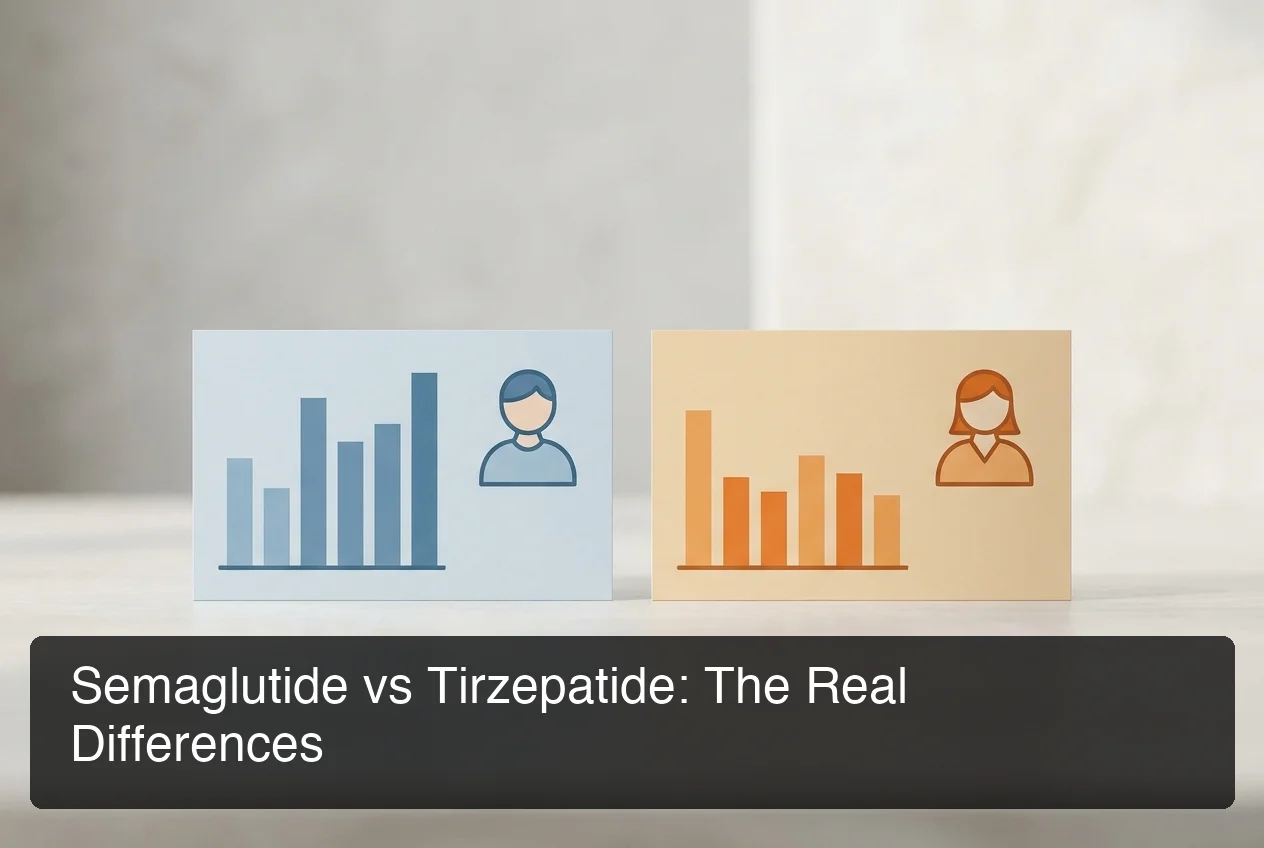 Head-to-head comparison of the two leading weight loss peptides across the factors that drive protocol selection.
What Side Effects Should You Expect on Weight Loss Peptides?
GLP-1 weight loss peptides produce nausea, fatigue, and appetite suppression during dose escalation — typically peaking in weeks 2–4 at each step. These are signs of pharmacological activity, not intolerance, and most side effects resolve within 4–6 weeks at a stable dose. GI disruption is the most common reason users slow their titration schedule.
Nausea typically begins when dose escalation starts and resolves within 2–4 weeks at each new dose level. Other common early side effects include constipation and occasional dizziness — expected as gut motility slows and appetite signaling shifts.
Reality check: GLP-1 side effects that persist past week 6 at a stable dose — or that disrupt daily function — are a signal to slow the titration, not to push through. The escalation schedule exists precisely for this. Faster titration is not always better titration.
Side effects that worsen after dose stabilizes, include unexplained abdominal pain, or don't track the expected timeline warrant a healthcare provider conversation. Not a Reddit thread.
How Long Does It Take to See Results From Weight Loss Peptides?
Most semaglutide users see initial weight loss by weeks 4–6 as appetite suppression stabilizes. Meaningful results — 5–10% body weight reduction — typically appear at the 3–4 month mark as titration completes. Tirzepatide tends to produce measurable results 2–4 weeks earlier at equivalent protocol stages.
The week-by-week picture is consistent across the data:
- Weeks 1–2: Appetite reduction begins. Scale movement is minimal to none.
- Weeks 3–4: First 1–3 lbs typically logged. Side effects at their peak.
- Months 2–3: Consistent 1–2 lb/week loss. Side effects largely resolved.
- Months 4–6: Most users reach 10–15% body weight reduction.
- Month 6+: Plateau risk increases — this is where tracking data becomes your early warning system.
Real-world result timelines and before/after patterns show one consistent finding: users who track weekly — adherence rates, side effect trends, wellness metrics, not just weight — catch and address plateaus 3–4 weeks earlier than those checking in monthly. On a 4-month protocol, that 3-week difference is roughly 18% of the total window.
What Does a Weight Loss Peptide Protocol Actually Cost?
Compounded GLP-1 peptides became broadly more accessible following the February 2026 policy shift. Current cost ranges by option:
- Compounded semaglutide: $200–$350/month
- Compounded tirzepatide: $300–$500/month
- Ozempic/Wegovy (branded): $800–$1,200/month at most out-of-pocket rates
- Mounjaro/Zepbound (branded): $1,000–$1,400/month without manufacturer coupons
- Protocol supplies (syringes, alcohol swabs, BAC water): $15–$25/month
The compounded route represents a significant reduction for users who don't qualify for manufacturer-covered prescriptions. Compared to long-term hormone-adjacent approaches, the cost structure of GLP-1 peptides versus HGH puts these numbers in useful perspective — GLP-1 protocols typically run substantially lower than multi-year HGH stacks for equivalent body composition goals.
The hidden cost is inconsistency. Missed doses, unmonitored plateaus, and dose-timing errors extend the effective protocol window. A well-tracked 4-month protocol often delivers what a poorly-managed 6-month protocol doesn't.
If combining weight loss with muscle preservation is part of your goal, the peptide selection logic changes — consider peptides that serve dual goals, which our upcoming guide on the best peptides for muscle growth covers in detail.
 PeptideIQ maps your semaglutide or tirzepatide protocol against your goal date and tracks adherence, weight trend, and side effects week by week.
How PeptideIQ Helps You Stay on Track
The protocols above are clear on paper. The variable that actually drives outcomes is execution: consistent dosing, early side effect awareness, and plateau detection before multiple weeks of progress disappear.
PeptideIQ's protocol recommendation engine is built specifically for this. When you set up your weight loss protocol, the app takes your goal timeline — a wedding date, a fitness event, a medical target — and maps a personalized titration schedule against that countdown. Someone four months out gets a different dose escalation structure than someone running an open-ended protocol: the pace is calibrated to the window, not borrowed from a generic titration guide.
Commitment level adapts the experience too. Users who log consistently see pace projections and plateau risk flags. Users who miss doses receive protocol adjustment suggestions tied to their specific adherence pattern.
Every Monday, a new AI insight card generates from that week's actual data — not a generic tip, but something specific: how your weight trend correlated with your adherence rate, whether your nausea pattern matches what's typical at your current dose, and what to watch for in the week ahead. That's the detailed dosing and response guidance we'll cover further in our upcoming semaglutide progression guide.
Get Started with PeptideIQ
Semaglutide and tirzepatide produce real, measurable results — but outcomes are tied directly to how consistently you manage the protocol. PeptideIQ gives you the tracking system, goal-anchored structure, and weekly AI insights to stay on course from week one.
Download PeptideIQ on the App Store
FAQ
What is the best peptide for weight loss?
Semaglutide and tirzepatide are the only weight loss peptides with large-scale FDA-approved clinical data, producing 15–22% average body weight reduction in phase III trials. Semaglutide is the stronger starting point for most first-time users: well-studied, predictable titration schedule, and an established side effect profile. Tirzepatide is the stronger choice for users who can tolerate a higher side effect load in exchange for faster results.
Do weight loss peptides actually work?
FDA-approved GLP-1 peptides have demonstrated consistent weight loss in randomized controlled trials across thousands of patients. They reduce appetite by 20–30%, slow gastric emptying, and alter hunger signaling at the brain level — mechanisms that explain why trial participants consistently outperform traditional diet interventions. Gray-market weight loss peptides have weaker evidence and significant quality control variability.
How long do you stay on weight loss peptides?
Most GLP-1 protocols run 3–6 months to reach target weight, followed by a tapering or maintenance period. Stopping abruptly typically reverses progress within months, as the hunger suppression effect ends. Clinical evidence increasingly treats GLP-1 therapy as a long-term metabolic intervention rather than a short cycle — your protocol length should match your goal and your tolerance for maintenance dosing.
Are weight loss peptides safe?
FDA-approved GLP-1 peptides have extensive safety data from large-scale trials; common side effects — nausea, fatigue, GI disruption — are manageable with proper dose titration, and serious adverse events are rare. Gray-market peptides carry substantially higher risk: FDA testing found incorrect dosages or undeclared ingredients in up to 40% of online peptide products tested. Quality control, not the compound itself, is the primary safety variable with non-prescription options.