
Can You Freeze Peptides? Storage Data | PeptideIQ
Can You Freeze Peptides? Storage Stability Data by Type
Minus 20°C keeps freeze-dried peptide powder stable for years. Left on a countertop, the same peptide can start degrading within days. That gap — years versus days — is exactly why so many people managing a real supply end up asking the same question: can you freeze peptides without losing potency, or does the cold do its own kind of damage?
Key Takeaways
- Freeze-dried peptide powder tolerates long-term freezer storage at -20°C or below; reconstituted liquid generally does not.
- Room-temperature peptides degrade fastest, refrigerated peptides hold for weeks to months, and frozen powder can remain stable for years.
- Repeated freeze-thaw cycles are the real threat to potency, not the act of freezing itself.
- Some peptides tolerate cold chain differently — GLP-1s like semaglutide and tirzepatide are notably more freezer- and fridge-stable than peptides like BPC-157.
- PeptideIQ calculates each vial's remaining shelf life automatically from storage temperature and peptide type, so the freeze-or-fridge decision isn't a guess.
Can You Freeze Peptides Without Damaging Potency?
Yes — freezing most peptides is safe and won't damage potency, as long as you're freezing freeze-dried (lyophilized) powder rather than a reconstituted liquid. Freeze-dried peptides tolerate long-term storage at -20°C or below for months to years. Reconstituted solutions are far more sensitive to freeze-thaw stress and generally shouldn't be frozen and thawed repeatedly.
The distinction matters because most peptide guidance online treats "freezing" as one single question. It isn't. Whether freezing helps or hurts depends on:
- The peptide's form — powder versus already-mixed liquid
- How many times the vial will be frozen and thawed
- The specific peptide's own stability profile
- How airtight and moisture-free the storage container is
A vial of unreconstituted BPC-157 powder and a vial of reconstituted tirzepatide behave completely differently in a freezer, even though both are "peptides."
How Long Do Frozen Peptides Last Compared to Refrigerated Ones?
Frozen freeze-dried peptide powder can remain potent for years at -20°C or below, refrigerated peptides typically hold for weeks to a few months depending on the compound, and room-temperature storage shortens shelf life to days or a couple of weeks. The table below breaks this down by form.
| Storage Method | Typical Temperature | Freeze-Dried Powder | Reconstituted Liquid |
|---|---|---|---|
| Room temperature | ~20–25°C | Days to about a week | Hours to 1–2 days |
| Refrigerated | 2–8°C | Weeks to several months | Roughly 2–4 weeks for most peptides; up to 90 days for some GLP-1s |
| Deep freezer | -20°C or below | Months to years | Not recommended for routine use — repeated freeze-thaw degrades structure |
By the numbers: In PeptideIQ's default expiry model, refrigerated BPC-157 is set to a 30-day shelf life, while refrigerated GLP-1 peptides like semaglutide and tirzepatide are set to up to 90 days — the same "refrigerated" label hides a 3x difference depending on the compound.
Those figures explain why blanket advice ("just refrigerate it") leaves people guessing. Do peptides need to be refrigerated walks through why cold storage is the default for most compounds, but freezing is the option that extends the runway further once refrigeration alone won't get you to your next order.
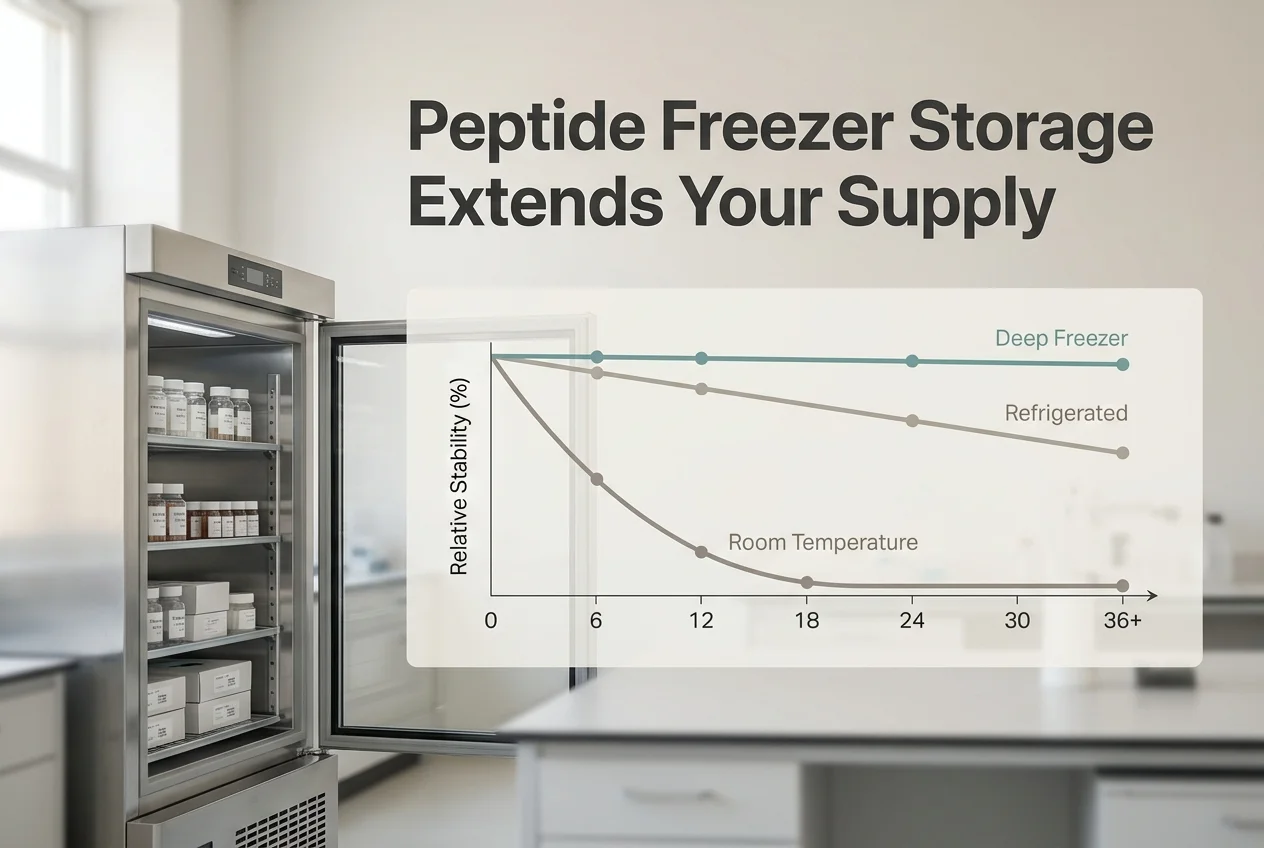 Room-temperature stability drops off within days; deep-freezer stability barely moves over the same stretch.
Can You Freeze Peptides in Powder Form, or Only as Liquid?
Freeze-dried peptide powder is the form that actually tolerates freezing well; reconstituted liquid peptide is the form that doesn't. Powder has no water content to form ice crystals, so it can sit in a deep freezer for months without structural damage. Liquid peptide, once mixed with bacteriostatic water, is mostly water — and water expands and crystallizes when frozen.
That expansion is the mechanism, not a vague warning. Ice crystals forming inside a reconstituted vial physically disrupt the peptide's folded structure, the same three-dimensional shape that makes it biologically active. Bacteriostatic water for peptides covers how that mixing step affects stability once a vial is opened — worth reading before deciding whether a specific reconstituted peptide is even a freezing candidate.
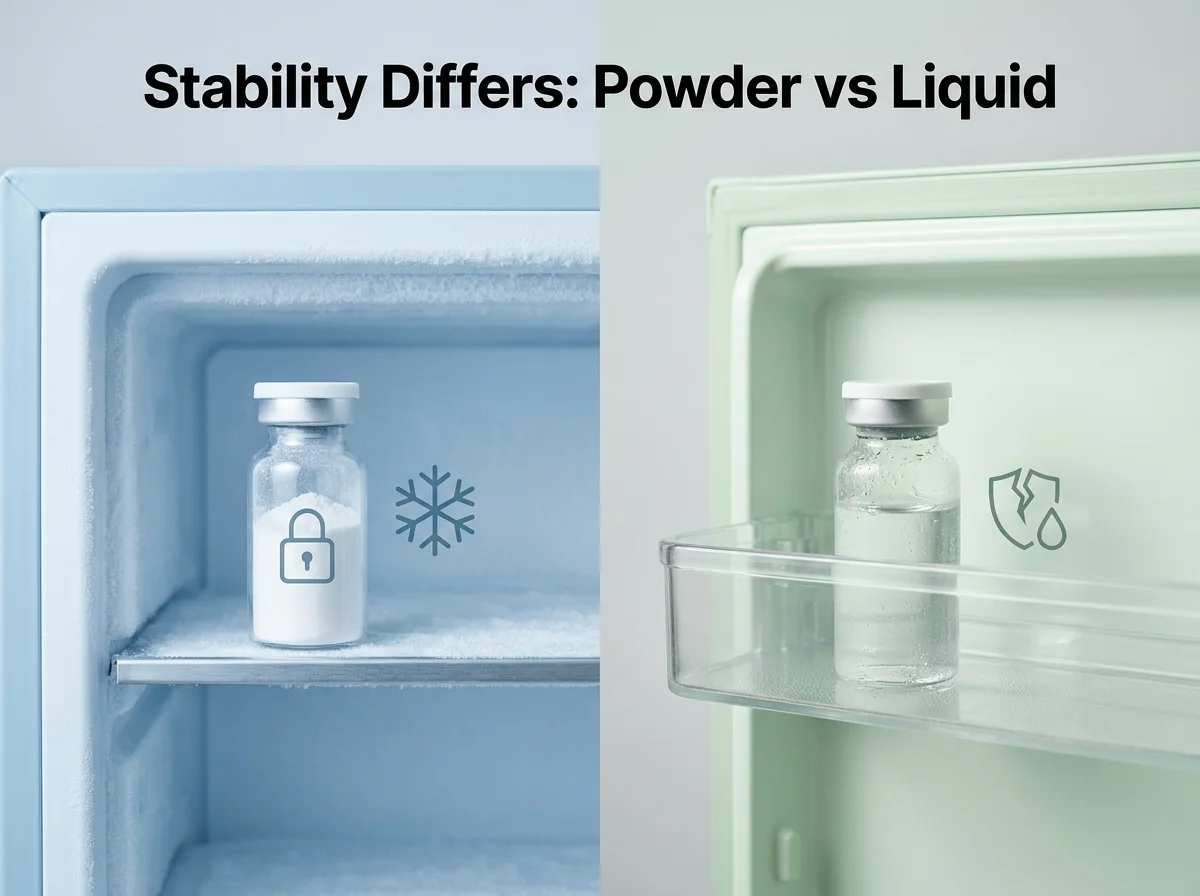 Powder has no free water to crystallize; reconstituted liquid does — that's the entire difference in freezer tolerance.
Practical takeaway: buy powder in advance and freeze what you won't reconstitute for months. Only mix what you'll use within the peptide's refrigerated shelf-life window.
Why Do Freeze-Thaw Cycles Damage Peptide Potency?
Freeze-thaw cycles damage peptide potency because each freeze forms ice crystals that stress the peptide's structure, and each thaw exposes it to temperature swings and possible moisture contamination. One freeze-thaw event on a reconstituted vial is a meaningful risk. Several repeated cycles compound that risk with every pass.
Worth knowing: The damage isn't cumulative in a simple additive sense — a vial frozen and thawed once isn't automatically "half as strong." But each additional cycle adds more opportunity for structural disruption, which is why the standard lab guidance across peptide suppliers is to aliquot a reconstituted solution into single-use portions rather than repeatedly freezing and thawing one vial.
This is also why pulling a reconstituted vial in and out of the freezer for convenience — rather than keeping it consistently refrigerated — tends to backfire. Consistent, single-state storage almost always outperforms repeated temperature swings.
What Temperature and Conditions Keep Frozen Peptides Stable?
Frozen peptide powder stays most stable at -20°C or below, stored in its original airtight, light-blocking container to keep moisture out. Moisture is the second enemy after temperature swings — a freezer that isn't frost-free, or a vial cap that isn't fully sealed, lets condensation into the powder over repeated door-openings.
A few conditions worth checking:
- Store vials upright in a dedicated section of the freezer, away from the door where temperature fluctuates most
- Keep the original desiccant packet with the vial if one was included
- Label the freeze date so you're not guessing how long a vial has been frozen
- Thaw once, fully, before reconstituting — never reconstitute a still-partially-frozen vial
Peptide vial storage goes deeper on the containers and moisture-protection setup that make freezer storage viable long term. If you're moving a frozen supply between locations, how to travel with peptides covers keeping that cold chain intact outside a stationary freezer. And once a frozen vial is thawed and ready to use, how to prepare peptides for injection picks up the thawing-to-injection handoff.
How PeptideIQ Removes Storage Guesswork
Knowing the general rules — powder freezes well, liquid doesn't, -20°C is the target — still leaves a gap: tracking which vial in your fridge or freezer is approaching its actual expiry date, for that specific peptide, under its specific storage conditions.
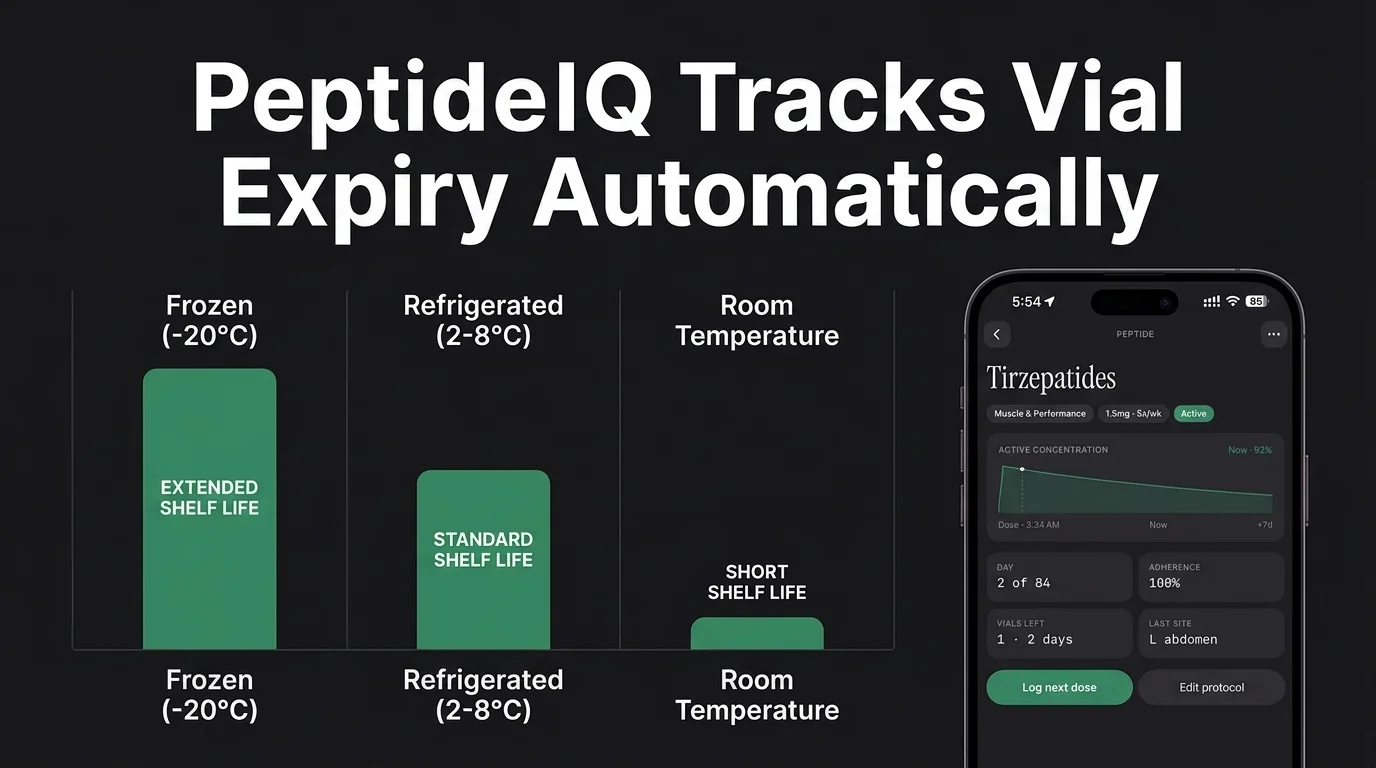 The app's per-vial view shows "VIALS LEFT 1 · 2 days" alongside a live concentration curve, so expiry isn't something you have to calculate by hand.
That per-vial view is pulled directly from PeptideIQ's inventory manager. When a vial is reconstituted, the app logs the mix date and calculates an expiry date automatically based on the peptide type — 30 days refrigerated for BPC-157, up to 90 days for GLP-1 peptides like semaglutide, and so on. The "vials left" count updates as doses are logged, and a low-stock or expiry warning fires before the vial actually runs out.
Get Started with PeptideIQ
If you're managing more than one vial across the fridge and freezer, tracking expiry by memory stops working fast. PeptideIQ logs reconstitution date, storage method, and peptide type per vial, then calculates the countdown for you.
Download PeptideIQ on the App Store
Freezing Peptides: Frequently Asked Questions
Can you freeze tirzepatide and other GLP-1 peptides? Yes, and GLP-1 peptides like tirzepatide and semaglutide tend to hold up better across storage methods than many other peptides, with refrigerated stability commonly rated up to 90 days. Freeze-dried tirzepatide can go into a deep freezer at -20°C; reconstituted tirzepatide should stay refrigerated and avoid repeated freeze-thaw.
Do freeze-thaw cycles completely ruin peptide potency? Not necessarily after one cycle, but repeated freezing and thawing compounds structural stress and moisture risk with each pass. The safest approach is aliquoting reconstituted peptide into single-use portions instead of freezing and thawing the same vial multiple times.
What temperature should a peptide freezer maintain? Most stability guidance points to -20°C or below for long-term freeze-dried peptide storage. A standard kitchen freezer set to its coldest setting typically reaches this range, though a dedicated lab or medical freezer offers more consistent temperature control.
What happens if peptides sit at room temperature too long? Room-temperature exposure accelerates degradation for nearly all peptides, with freeze-dried powder typically holding a matter of days and reconstituted liquid degrading within hours to a couple of days. Once potency drops, there's no way to restore it — the vial should be treated as compromised rather than risked.