
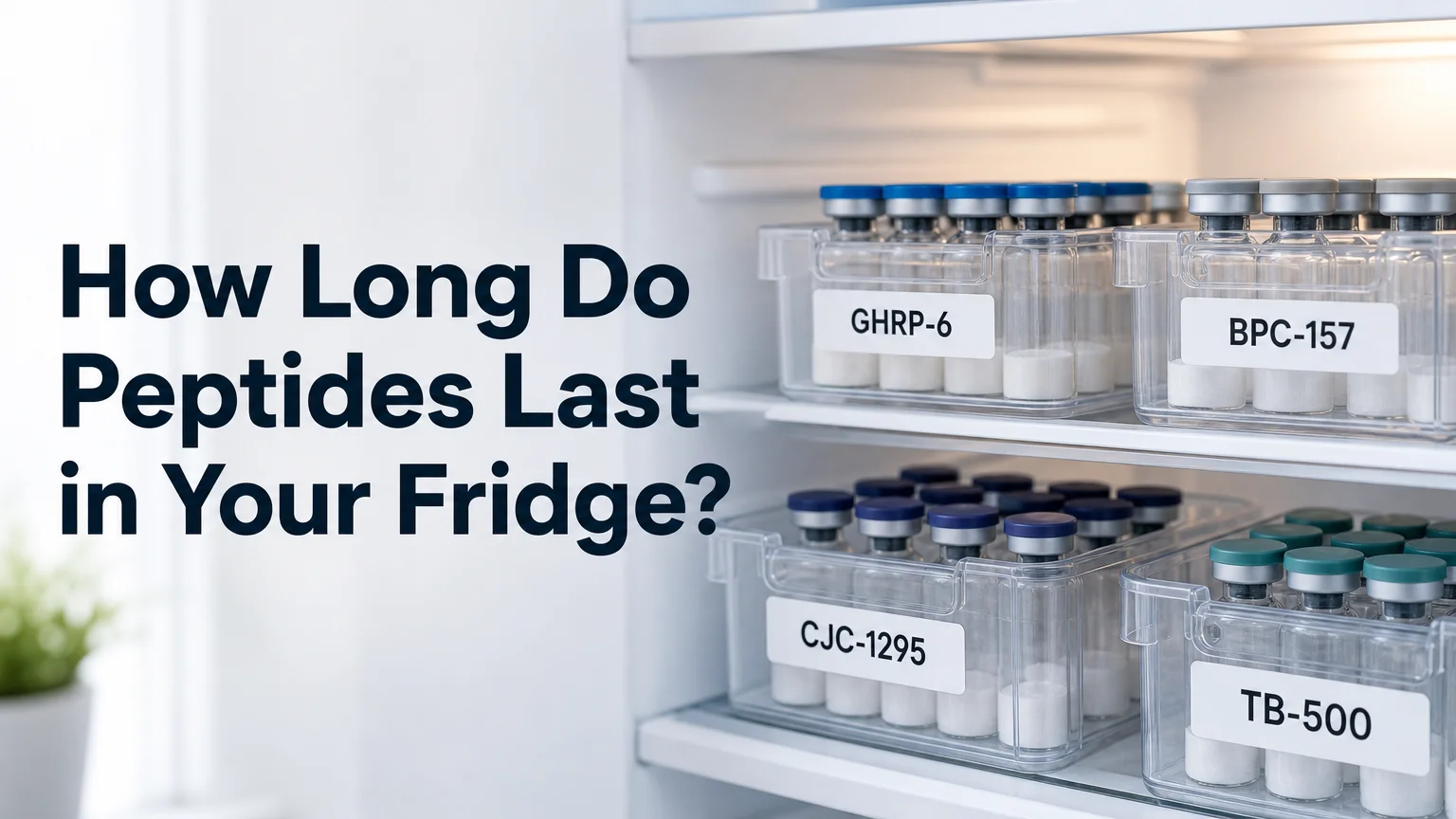
How Long Do Peptides Last in Fridge? | PeptideIQ
How Long Do Peptides Last in Fridge Storage? A Shelf-Life Breakdown
How long do peptides last in fridge storage? It comes down to one variable most people skip past: which peptide it actually is.
Reconstituted BPC-157 holds for roughly 30 days at 2–8°C, a reconstituted GLP-1 like semaglutide or tirzepatide can stretch to 90, and unopened lyophilized powder kept cold and dry can remain stable for years. That gap is exactly where most storage mistakes happen.
Key Takeaways
- Reconstituted peptides stored at 2–8°C typically last 30–90 days depending on the peptide type.
- Frozen powder peptides remain stable for years if kept at -20°C or colder.
- Room-temperature storage drastically shortens shelf life and risks peptide degradation.
- Expiry depends on the specific peptide, reconstitution method, and storage temperature — there's no single number that applies to every vial.
- PeptideIQ's inventory system auto-calculates expiry dates by peptide type and alerts you before a vial expires.
How Long Do Peptides Last in Fridge Storage, by Type?
Reconstituted peptides typically last 20 to 90 days in the fridge at 2–8°C, depending on the specific compound — BPC-157 and TB-500 sit near 30 days, growth hormone peptides like CJC-1295 and Ipamorelin run 20–30 days, and GLP-1s such as semaglutide and tirzepatide can hold up to 90. The number on a supplier's label is a starting point, not a guarantee — it assumes correct reconstitution, sterile handling, and unbroken refrigeration the entire time.
Here's how the shelf-life windows break down by type:
| Peptide Type | Fridge Shelf Life (Reconstituted) | What Happens After That Window |
|---|---|---|
| BPC-157 | ~30 days | Potency declines gradually; dosing becomes less predictable |
| TB-500 | ~30 days | Similar decline curve to BPC-157 |
| CJC-1295 / Ipamorelin | ~20–30 days | More sensitive to temperature swings, shorter safe margin |
| GHK-Cu | ~20–30 days | Copper complex is also light-sensitive, not just heat-sensitive |
| GLP-1s (semaglutide, tirzepatide) | Up to 90 days | Longest reconstituted fridge stability of common peptides |
Reconstituted peptide shelf life isn't a marketing number — it reflects how quickly the peptide bond breaks down once it's in liquid form. Peptide storage temperature covers why the 2–8°C range specifically matters chemically, not just as a rule of thumb.
Worth knowing: GLP-1s outlasting BPC-157 by 2–3x in the fridge surprises a lot of people who assume "peptide" means one universal shelf-life rule. It doesn't — formulation and molecular stability vary that much between compounds.
What's the Shelf Life of Frozen Peptides?
Unopened lyophilized (freeze-dried) peptide powder can remain stable for years when frozen at -20°C or colder, kept dry, and protected from light. That's a fundamentally different clock than the one that starts the moment a peptide gets reconstituted with bacteriostatic water.
Freezing already-reconstituted peptide is a separate question, and the answer is less clean. Repeated freeze-thaw cycles can physically damage peptide structure — ice crystal formation disrupts the molecule in ways that consistent 2–8°C refrigeration doesn't.
Whether you should freeze peptides at all really depends on the form: powder freezes well, but most guidance recommends against freezing reconstituted vials for that same reason. Our freezer storage guide goes deeper on which forms tolerate freezing and which don't.
The short version: Freeze the powder before you mix it, not after. Once BAC water is in the vial, the fridge — not the freezer — is the safe long-term home.
Does Reconstitution Affect How Long Your Peptides Stay Fresh?
Yes — reconstitution is what starts the shelf-life clock. Dry, lyophilized powder can sit stable for years, but the moment bacteriostatic water is added, the peptide is in an active liquid environment where hydrolysis and oxidation begin working against it immediately. The bacteriostatic water itself, usually containing 0.9% benzyl alcohol, prevents bacterial growth — it does nothing to slow the peptide's own chemical breakdown.
That's the core reason a vendor's "years of shelf life" claim and a user's "30 days after mixing" reality aren't in conflict. They're describing two completely different chemical states of the same peptide.
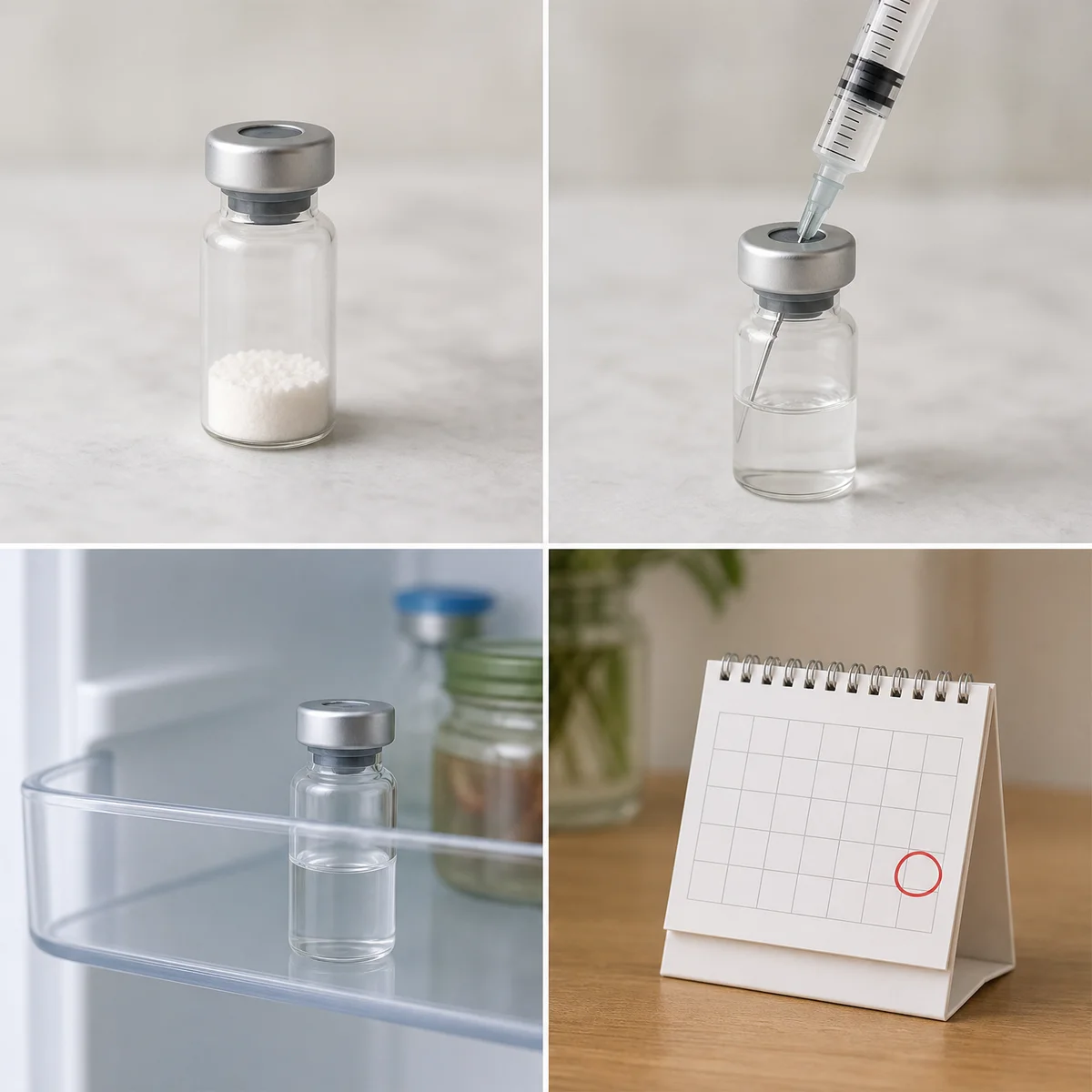 The clock starts the moment BAC water touches the powder — not when the vial was purchased.
Every freeze-thaw cycle after reconstitution compounds the problem. Pulling a vial in and out of the fridge repeatedly, or leaving it on a counter mid-dose, adds up faster than a single lapse would suggest.
What Temperature Is Best for Storing Peptides?
The ideal storage temperature for reconstituted peptides is 2–8°C — standard refrigerator temperature — with the back of the fridge, away from the door, holding the most consistent reading. Door shelves swing several degrees every time the fridge opens, which matters more than people expect over a 30–90 day window.
Peptide stability temperature research consistently points to this same narrow band regardless of which specific peptide is involved. It's the reconstitution-specific shelf life that varies by compound, not the ideal storage zone itself.
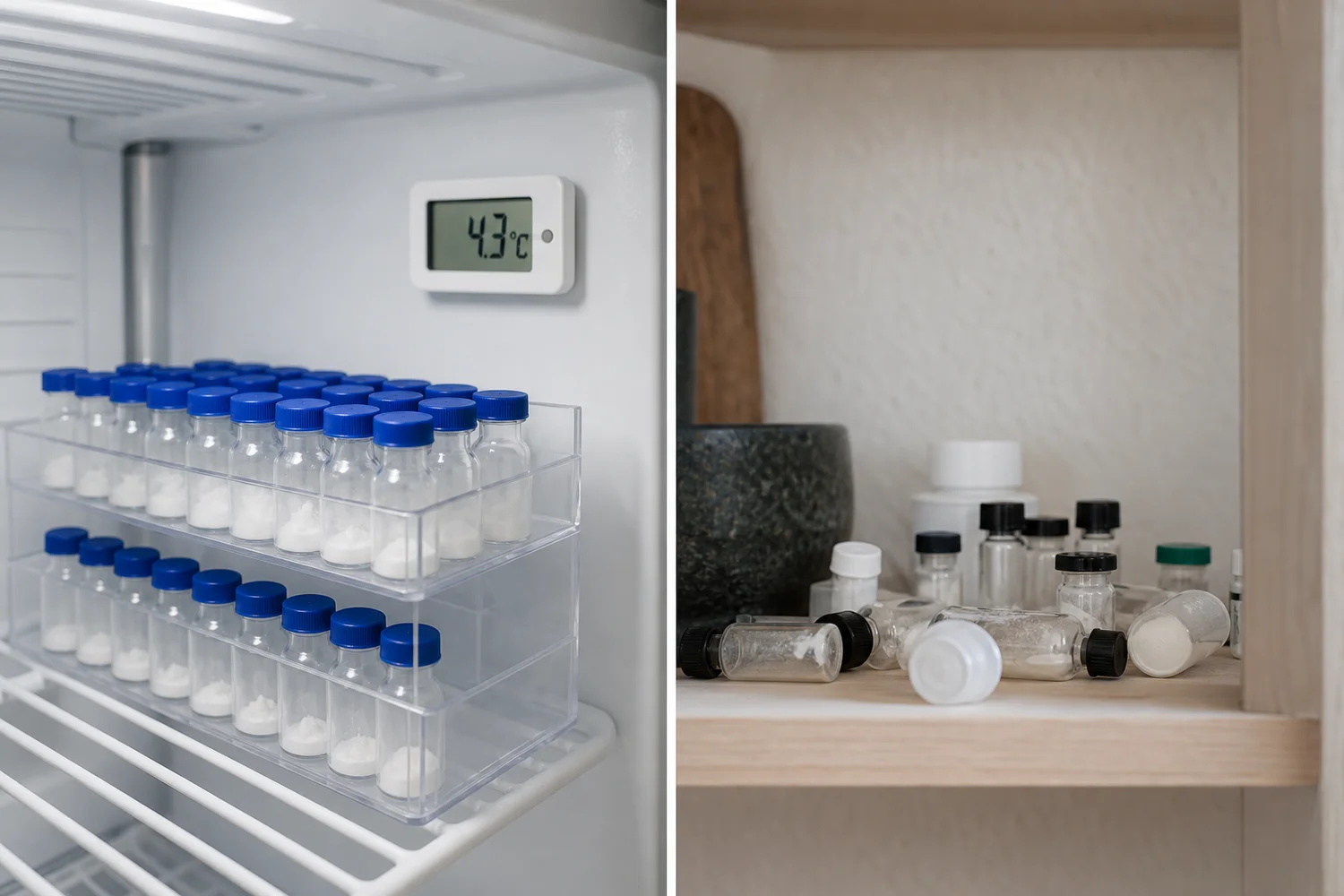 Same vials, two different outcomes — the difference is entirely in the setup.
A dedicated bin or door-free shelf spot keeps temperature stable and makes vials easy to find without digging past food. Our full guide to storing peptides covers containers, labeling, and humidity alongside temperature. If refrigeration itself is still an open question for you, our refrigeration primer covers the yes/no case directly.
Reality check: A fridge thermometer costs less than a single vial of most peptides. If you're not measuring the actual temperature, "2–8°C" is a guess, not a fact.
How Long Do Peptides Last in Fridge vs at Room Temperature?
Left at room temperature, reconstituted peptides start losing meaningful potency within hours, not days — a sharp contrast to the 20–90 day window refrigeration provides. A vial forgotten on the counter overnight isn't instantly worthless, but it's also not the same product it was the day before.
What this means for you: Treat anything left unrefrigerated for more than a few hours as compromised. Dose it if you must, but don't assume it matches the potency your protocol was calculated around.
Powder is more forgiving. Unreconstituted, lyophilized peptide can tolerate brief room-temperature stretches, like a few days in transit, without much consequence — a tolerance that disappears completely once it's mixed with water.
How Do You Know When Your Peptides Have Expired?
Visible signs of expired peptide include cloudiness, discoloration, and visible particles in an otherwise clear solution — but potency loss from heat or age typically happens well before any of those signs appear. That lag is the real risk: a vial can look completely normal and still be significantly degraded.
Watch for:
- Cloudy or hazy solution that was clear at reconstitution
- Any color shift, even subtle yellowing
- Visible flecks, particles, or sediment
- A smell that wasn't present at mixing
- Vial age past its calculated expiry window, even with no visible change
If any of these show up, treat the vial as unusable rather than testing your luck on a compound you're injecting.
Can You Store Different Peptides in the Same Fridge?
Yes — different peptides can share a fridge safely as long as each vial is clearly labeled and stored separately. The risk isn't chemical interaction between peptides, it's mixing up which vial is which. Two unlabeled vials that look identical is how people accidentally dose the wrong peptide or lose track of which one is closer to expiry.
A shared bin works fine for most home setups. What matters is labeling each vial with the peptide name and reconstitution date, and keeping them separated enough that grabbing the wrong one takes real effort. Our peptide vial storage guide covers containers and labeling systems in more depth for anyone running more than one or two peptides at once.
Common mistake: Relying on memory for which vial was mixed when. With more than one peptide active, that's exactly the kind of detail that gets confused within a week.
How PeptideIQ Removes the Guesswork
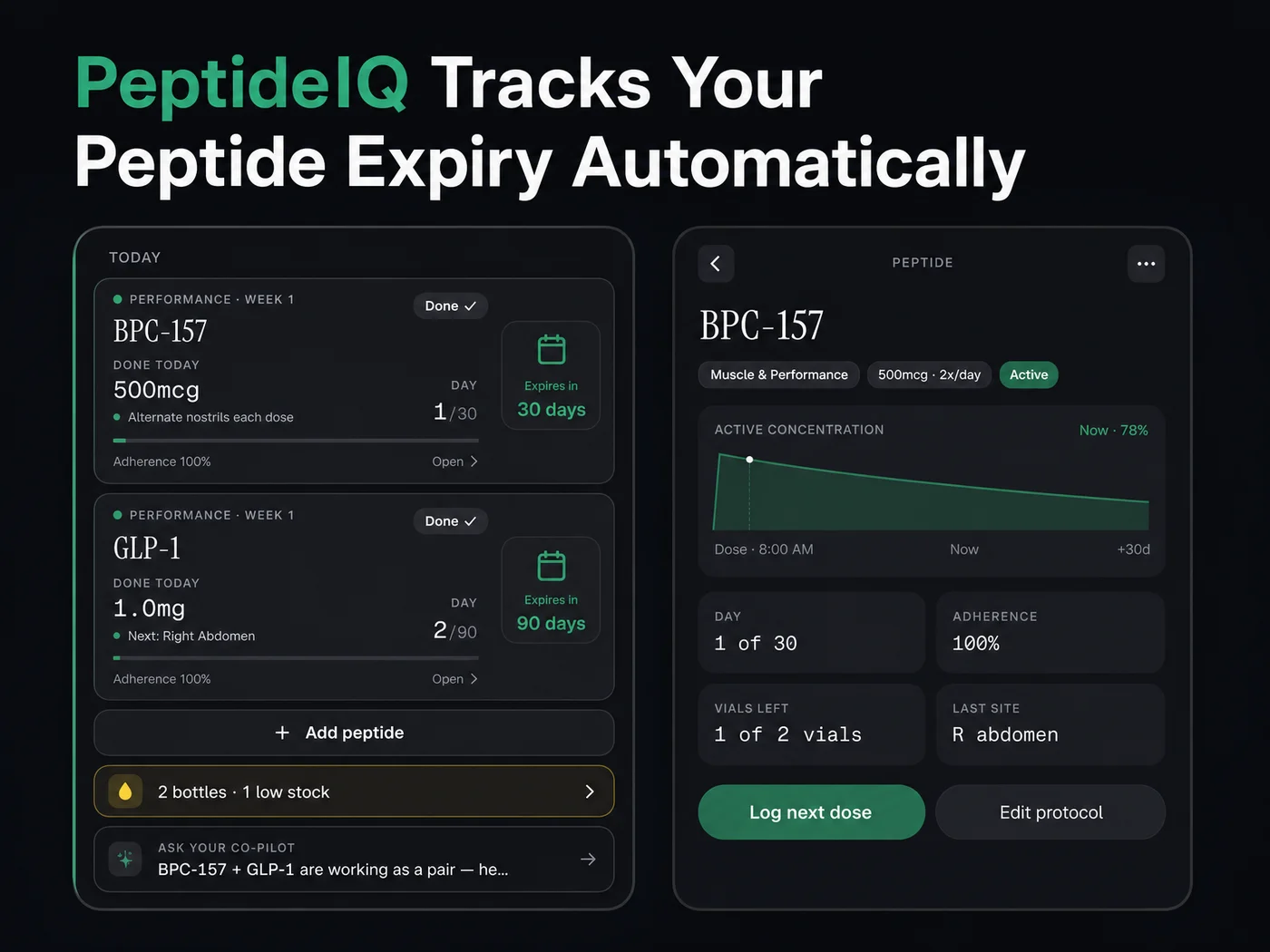 The same shelf-life math from the table above, calculated automatically for every vial in your fridge.
Manually tracking reconstitution dates across two, three, or four active peptides means running the shelf-life table above in your head, every time. PeptideIQ's Inventory Manager does that math automatically — log a vial as reconstituted, and the app calculates its expiry date by peptide type: roughly 30 days out for BPC-157, up to 90 for a GLP-1, without you doing anything.
Each vial's record tracks concentration and doses remaining, decrementing automatically with every logged dose. Five days before a vial's calculated expiry, PeptideIQ sends a single alert, not a daily nag, so a peptide doesn't quietly expire in the back of the fridge because nobody was watching the calendar.
That's the difference between reading a shelf-life table and having the app apply it to your actual vials, automatically, every time you dose.
FAQ
Do Peptides Go Bad in the Refrigerator?
Yes — even refrigerated peptides eventually degrade, since refrigeration slows the process rather than stopping it. Reconstituted peptides typically hold potency for 20–90 days at 2–8°C depending on the compound, after which dosing accuracy becomes less reliable even without visible spoilage signs.
How Long Can Peptides Sit Out of the Fridge?
Reconstituted peptides start losing meaningful potency within hours at room temperature, though a single short lapse of an hour or two usually isn't catastrophic. Treat anything left out overnight or longer as compromised, and refrigerate immediately once you notice the lapse.
What Is the Shelf Life of a Peptide?
It depends entirely on form and type. Lyophilized powder frozen at -20°C or colder can last years; reconstituted peptides in the fridge typically last 20–90 days, with BPC-157 near 30 days and GLP-1s up to 90.
How Long Can BPC-157 Stay Unrefrigerated?
Reconstituted BPC-157 left unrefrigerated should be treated as degrading within hours, not days, since its roughly 30-day fridge shelf life assumes consistent 2–8°C storage throughout. A brief lapse doesn't necessarily ruin the vial, but extended room-temperature exposure meaningfully shortens its usable window.