
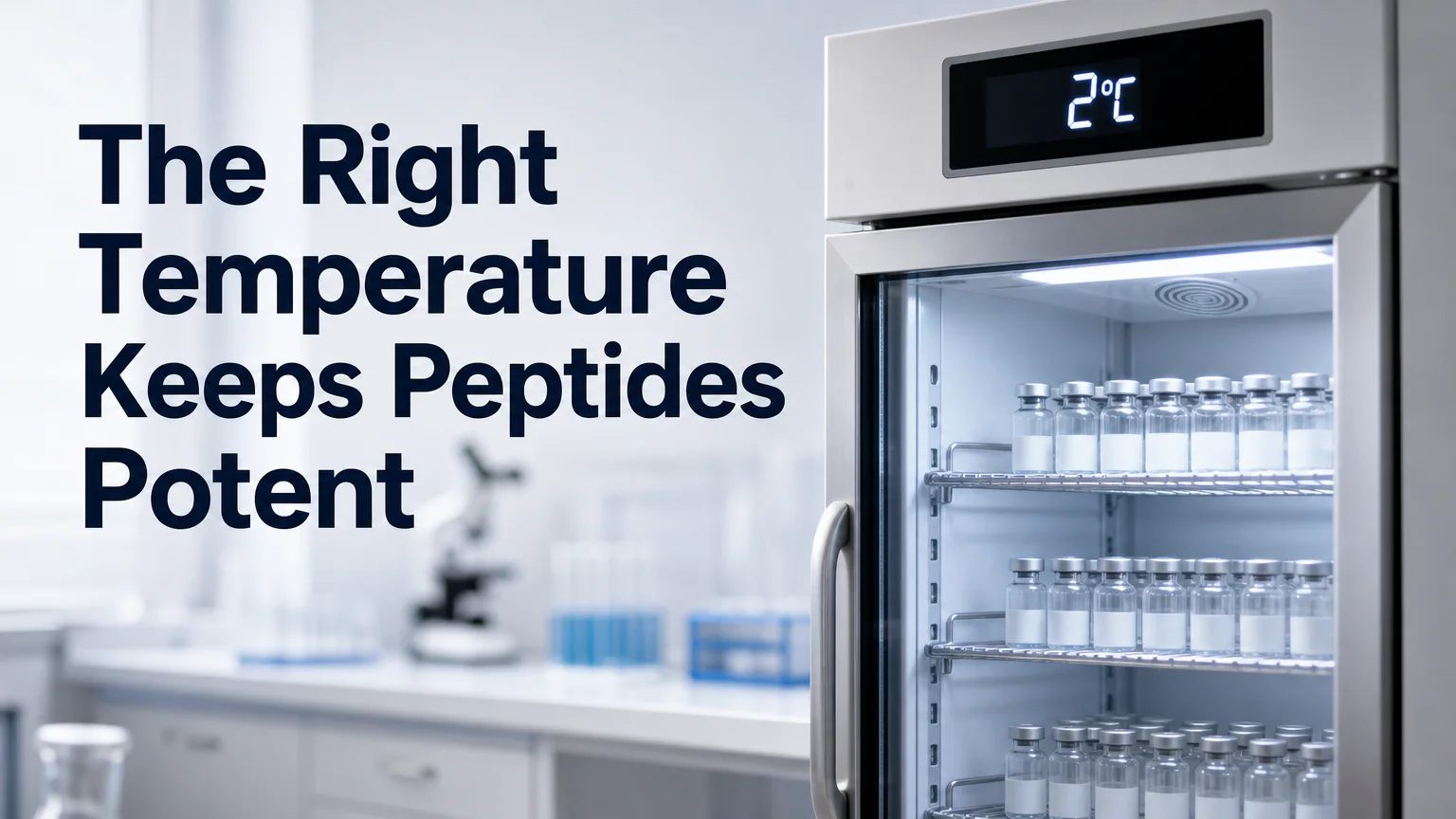
Peptide Storage Temperature: The Full Range
Peptide Storage Temperature: The Exact Range for Every Type
Peptide storage temperature comes down to two numbers: 2°C to 8°C for anything reconstituted, and -10°C to -20°C for unopened lyophilized powder you're saving for later. Get either one wrong for more than a few days and potency starts dropping — sometimes within hours at room temperature. FDA testing found up to 40% of online peptide products already carry incorrect dosages or undeclared ingredients; bad storage stacks a second way to end up injecting something other than what you paid for.
What Is the Optimal Peptide Storage Temperature?
The optimal peptide storage temperature depends on form: reconstituted peptides (mixed with bacteriostatic water) need refrigeration at 2°C to 8°C and are typically stable for around 30 days, while unopened lyophilized powder holds up far longer in a freezer between -10°C and -20°C. Room temperature works only for the few minutes it takes to draw a dose, not for ongoing storage.
Peptide suppliers like GenScript and Bachem recommend -20°C for long-term lyophilized storage, and that guidance holds up across the research-grade supply chain. The moment BAC water goes into the vial, the clock changes — reconstituted peptide is a fragile liquid protein solution, not a shelf-stable powder anymore. If you'd rather freeze peptides than track a 30-day fridge window, the type-by-type breakdown of what actually tolerates freezing is worth reading before you commit vial space in the freezer.
A quick reference for what actually matters:
- Lyophilized (unopened) powder: -10°C to -20°C freezer, stable for months to years
- Reconstituted peptide: 2°C to 8°C fridge, most types good for roughly 30 days
- Brief handling: room temperature is fine for the minute or two it takes to draw a dose
- Never: direct sunlight, a car glovebox, or the freezer door (temperature swings faster there than anywhere else in the unit)
Key Takeaways
- Most reconstituted peptides stay stable for 30+ days when refrigerated at 2–8°C, but degrade rapidly at room temperature.
- Freezing peptides below -10°C extends shelf life by months or years for powder and some reconstituted formulations, but not all types freeze equally well.
- Storage temperature varies by peptide type — BPC-157 differs from GLP-1s, which differ from growth hormone peptides — so generic "keep it cold" advice misses real nuance.
- A dedicated tracking system that logs storage conditions and calculates expiry by peptide type prevents accidental use of degraded product.
- Temperature stability data is the evidence that justifies investing in proper storage infrastructure instead of guessing.
Why Does Storage Temperature Affect Peptide Potency?
Peptides are chains of amino acids held together by bonds that break apart through hydrolysis and oxidation, and both reactions speed up as temperature rises. Heat gives molecules more energy to react — cold storage simply slows that process down, the same principle behind refrigerating any protein-based product, just with tighter margins.
At room temperature, a reconstituted peptide can lose meaningful potency within days rather than weeks. Light exposure and repeated temperature swings — pulling a vial in and out of the fridge — compound the damage faster than steady cold storage ever would.
Worth knowing: A vial that's been through five warm-to-cold cycles has usually lost more potency than one kept at a stable 4°C the entire time, even if both spent the same total hours outside the fridge.
What Temperature Should Reconstituted Peptides Be Stored At?
Reconstituted peptides should sit at 2°C to 8°C — standard refrigerator temperature — and most types are formulated to hold roughly 30 days at that range before potency drops meaningfully. That's the core of every reasonable peptide refrigeration requirement you'll find, whether it's coming from a supplier's technical sheet or a research lab's SOP.
BPC-157 is the clearest example: reconstituted and refrigerated at 2-8°C, it's generally good for about 30 days. Push past that window and you're not necessarily dealing with something dangerous — you're dealing with something less effective, which for an expensive vial defeats the point of using it at all. If you're still deciding whether the fridge is mandatory in the first place, our refrigeration primer covers the yes/no case in more depth.
Peptide Storage Temperature by Type
Generic "keep it cold" advice glosses over real differences between peptide classes. Reconstituted peptide shelf life and the ideal peptide stability temperature both shift depending on what's actually in the vial:
| Peptide Type | Reconstituted (2-8°C Fridge) | Frozen Powder (-10°C to -20°C) | Notes |
|---|---|---|---|
| BPC-157 | ~30 days | Months to years | Most-cited stability window in supplier data |
| GLP-1s (semaglutide, tirzepatide) | Up to 90 days | Months to years | Longer fridge stability than most peptides |
| Growth hormone peptides (CJC-1295, Ipamorelin) | ~20-30 days | Months | More sensitive to temperature swings |
| TB-500 | ~30 days | Months to years | Similar profile to BPC-157 |
| GHK-Cu | ~20-30 days | Months | Copper complex is light-sensitive as well as heat-sensitive |
This is exactly why a single "store peptides cold" rule undersells what's actually going on chemically — and why matching the right window to the right peptide matters more than most vendor pages let on. Temperature is one piece of the puzzle; for the containers, placement, and handling habits that round out the picture, see our full guide to storing peptides.
Can You Store Peptides at Room Temperature?
Lyophilized powder can tolerate brief room-temperature exposure — a few days during shipping, for instance — without meaningful damage, but reconstituted peptide cannot. Once liquid, a vial left at room temperature is degrading in real time, not sitting in a safe holding pattern.
A vial forgotten on the counter overnight isn't automatically ruined, but it's also not the same product it was the day before. Treat anything left unrefrigerated for more than a few hours as compromised, not as fine just because it looks unchanged.
Traveling adds its own version of this problem — a cooler bag that warms up mid-flight defeats the purpose just as fast as a kitchen counter. Our guide to traveling with peptides walks through keeping cold chain intact away from home.
What Happens If Peptides Get Too Warm?
Peptides exposed to sustained heat lose potency through accelerated degradation, and in more extreme cases show visible signs — clouding, discoloration, or particles — that indicate the protein structure has broken down. A clear vial that turns cloudy or develops visible flecks should be treated as unusable regardless of how long it's been stored.
The degradation curve isn't linear across storage conditions. A peptide held at a stable fridge temperature loses potency gradually over its full 30-day window, while the same peptide at room temperature can hit that same potency loss in a fraction of the time — and freezing well below -10°C flattens the curve almost entirely for the types that tolerate it.
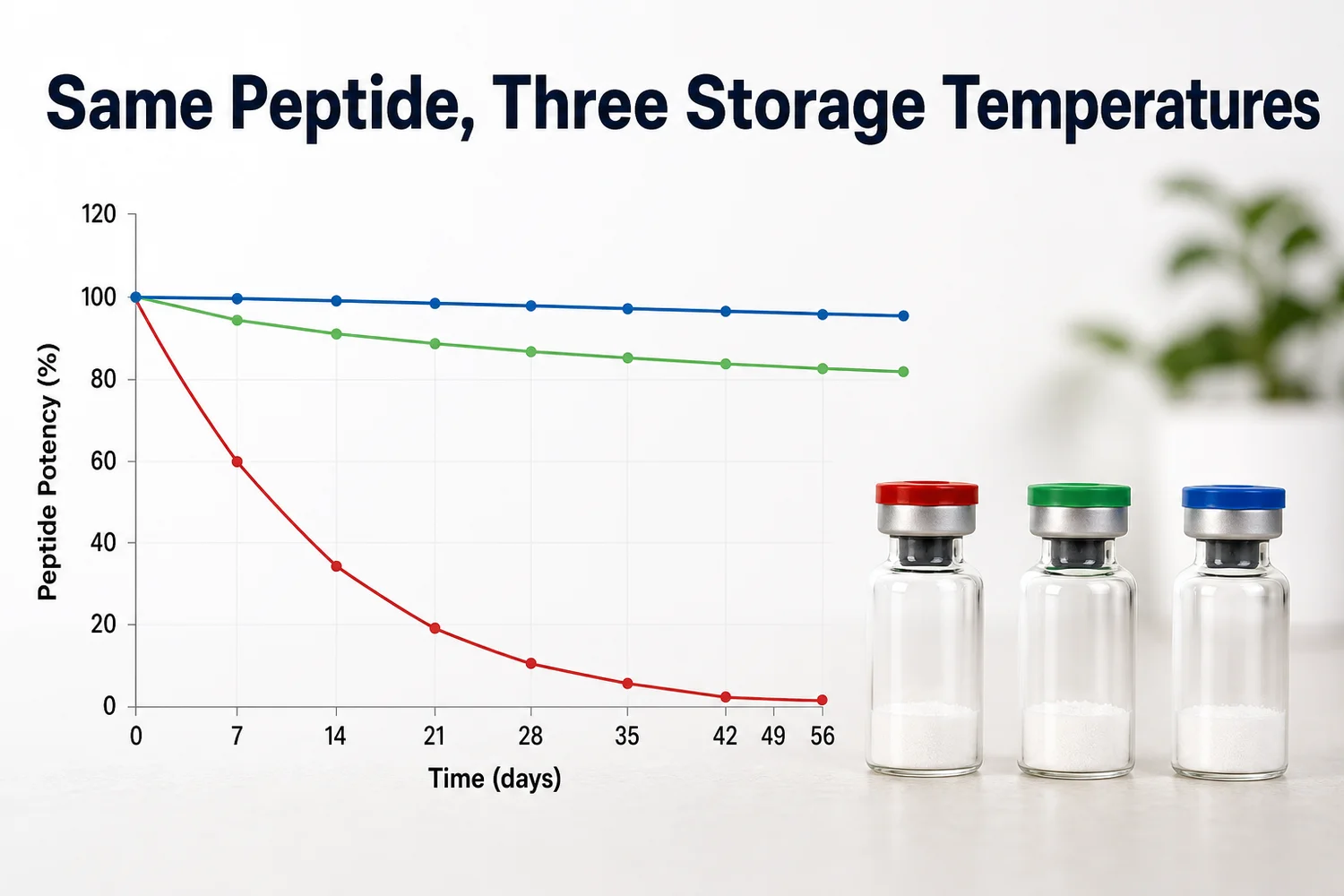 Three storage conditions, three very different potency curves for the same vial.
Common mistake: Assuming a peptide is fine because it still looks clear. Potency loss from heat exposure typically happens well before any visible change shows up in the vial.
Why Storage Temperature Tracking Matters
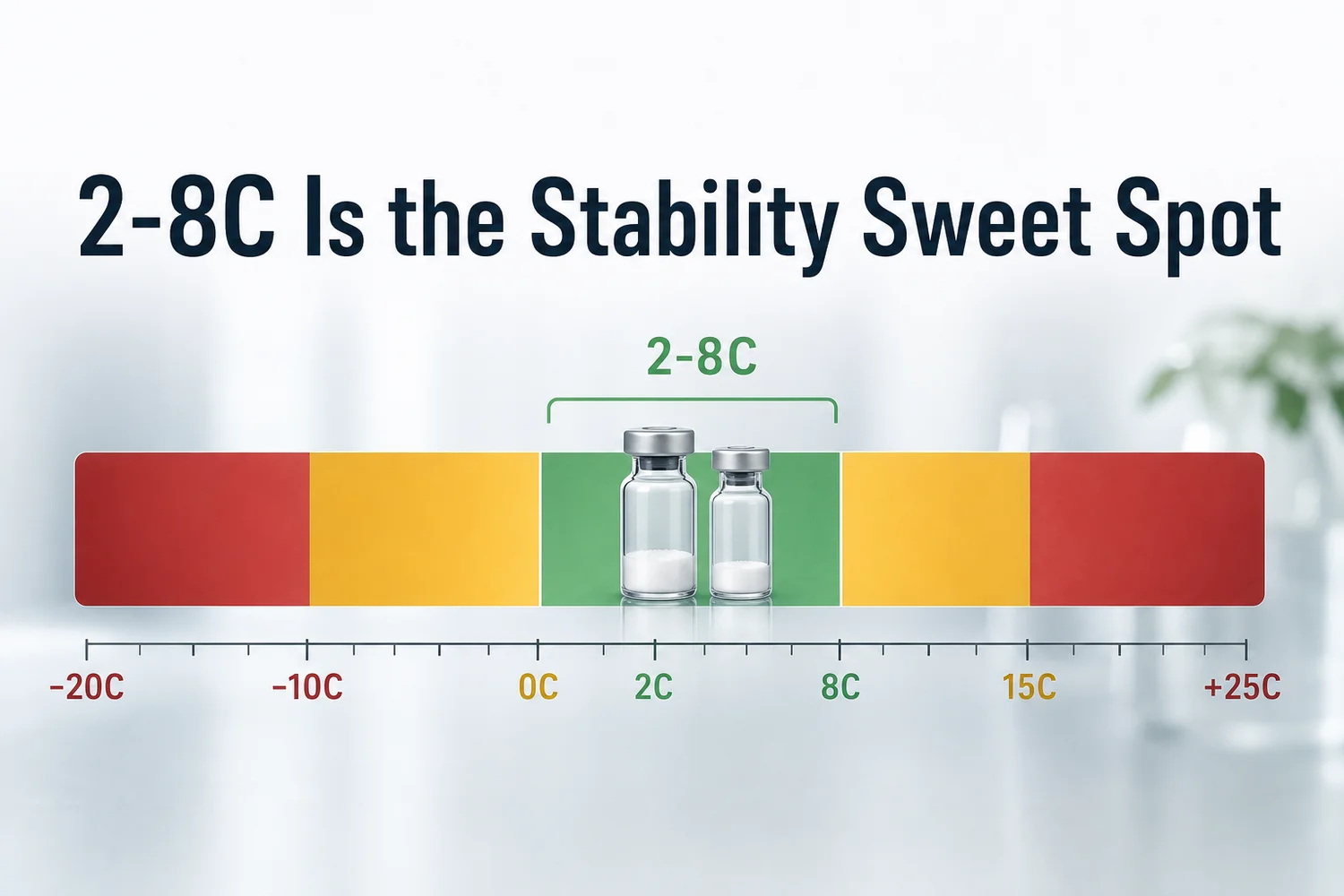 The 2-8°C window is narrow — which is exactly why it's easy to drift out of without noticing.
Knowing the right temperature range only helps if you actually know whether your storage has stayed inside it — which is where most people's tracking breaks down. A sticky note on the fridge or a mental note of "reconstituted last week" doesn't hold up once you're managing more than one vial.
PeptideIQ's Inventory Manager tracks storage requirements and calculates an expiry date automatically by peptide type — 2°C to 8°C for most peptides, with BPC-157 set to its roughly 30-day reconstituted window and longer windows for anything frozen below -10°C. The app sends an expiry warning five days before that calculated date, so a vial doesn't get used past its stability window just because nobody was tracking it manually.
For anyone running more than one peptide, that's the difference between a system and a guess — the app already knows the rules and applies them to your specific vials automatically. If vial materials and placement matter as much to you as the fridge setting, our peptide vial storage guide covers that other half of the equation.
Get Started with PeptideIQ
Storage temperature is only half the equation — knowing exactly when each vial expires, based on its specific reconstitution date and peptide type, is what actually prevents wasted product. PeptideIQ's Inventory Manager handles that calculation automatically and warns you before a vial goes bad.
FAQ
At What Temperature Do Peptides Go Bad?
Reconstituted peptides start losing meaningful potency above roughly 8°C, with degradation accelerating the warmer and longer the exposure. Lyophilized powder is more forgiving short-term but shouldn't sit above room temperature for extended periods. Consistent refrigeration at 2-8°C is the safe operating range for anything already mixed.
Will Peptides Go Bad If Not Refrigerated?
Reconstituted peptides left unrefrigerated degrade quickly — often within days rather than weeks — because the liquid form accelerates the same hydrolysis and oxidation reactions that heat speeds up. Unopened lyophilized powder tolerates brief room-temperature stretches (like shipping) far better than anything already mixed with water.
Do Peptides Really Go Bad After 30 Days?
The roughly 30-day window applies specifically to reconstituted peptides like BPC-157 stored at 2-8°C — it's a stability estimate, not a hard cutoff where the vial suddenly becomes unusable. Potency declines gradually past that point rather than dropping off a cliff, but usage past 30 days means less predictable dosing.
What Happens If I Forgot to Put My Peptides in the Fridge Overnight?
A single overnight lapse at typical indoor room temperature usually causes some potency loss but doesn't automatically ruin the vial. Refrigerate it immediately, check for cloudiness or discoloration, and treat the remaining shelf life as shortened rather than assuming nothing changed.