

What Are the 5 Best Peptides for Your Goals?
What Are the 5 Best Peptides for Your Goals?
Search "what are the 5 best peptides" and most results hand you a single list, as if a wedding-focused dieter, a lifter chasing recovery, and a 47-year-old reading about longevity are all solving the same problem. They're not — and treating "best" as one universal ranking is how most guides go wrong before they even start.
Key Takeaways
- The "best peptide" depends entirely on your goal: weight loss (semaglutide, tirzepatide), muscle growth (CJC-1295 + Ipamorelin), recovery (BPC-157), longevity (GHK-Cu, Epitalon), and cognitive support (Semax, Selank) solve different problems
- Evidence levels vary widely — semaglutide is FDA-approved, BPC-157 has strong animal data, and some longevity peptides are still anecdotal. Honest labels matter more than hype
- Beginners usually start with BPC-157 or a GLP-1 because the protocols are well-documented, side effects are predictable, and the risk profile is low
- Tracking your actual results — energy, weight, pain, adherence — is what reveals whether a peptide works for your body, not the label on the vial
- PeptideIQ shows you week-by-week whether your protocol is working, so you're adjusting with data instead of guessing
Contents
- What Are the 5 Best Peptides for Your Goals?
- Which Peptide Is Best for Weight Loss — Semaglutide or Tirzepatide?
- Which Peptides Are Best for Muscle Growth and Recovery?
- What's the Best Peptide for Anti-Aging and Longevity?
- How Do You Know Which Peptide Is Right for Your Body?
- How PeptideIQ Helps You Choose (and Track) Your Peptide
- Should You Start with One Peptide or Stack Multiple?
What Are the 5 Best Peptides for Your Goals?
What are the 5 best peptides? There isn't one answer — the five that matter most map to five different goals: semaglutide or tirzepatide for weight loss, CJC-1295 with Ipamorelin for muscle growth, BPC-157 for recovery, GHK-Cu for longevity, and Semax for cognitive clarity. Each one solves a different problem, and picking based on popularity instead of goal is the most common mistake people make.
None of these five are interchangeable, and none are automatically safe just because they're popular. What follows is a goal-by-goal breakdown, the evidence behind each one, and — because a "best" peptide with no tracking behind it is really just a guess — how to actually know if it's working for you.
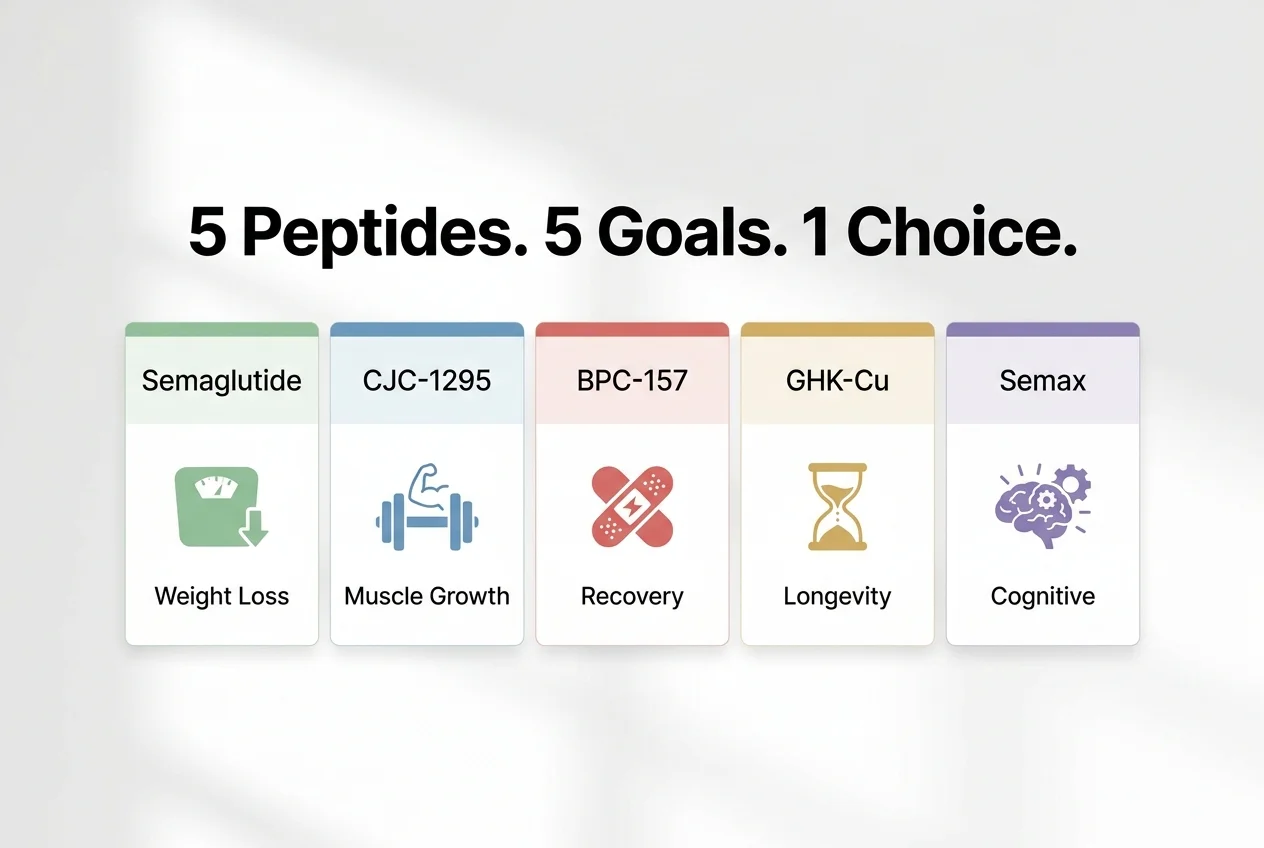 Five peptides, five distinct goals — the starting map before you pick anything.
Which Peptide Is Best for Weight Loss — Semaglutide or Tirzepatide?
For weight loss, semaglutide and tirzepatide are the best-supported peptides available — both are FDA-approved GLP-1 receptor agonists, with tirzepatide showing slightly stronger average weight loss in head-to-head trials because it also activates a second hormone pathway (GIP). Semaglutide is better documented and more widely compounded; tirzepatide tends to produce faster early results for some users.
Semaglutide works by slowing gastric emptying and signaling fullness to the brain, which is why appetite — not willpower — does most of the work. Tirzepatide adds a GIP-receptor effect on top of that GLP-1 mechanism, which is the likely reason trial participants on tirzepatide lost more weight on average than those on semaglutide alone.
Neither peptide is "better" for everyone. Someone with a strong GI sensitivity may tolerate semaglutide's more gradual onset better than tirzepatide's often-faster titration curve.
By the numbers: Semaglutide and tirzepatide combined generated nearly $30 billion in revenue in 2024 — the single biggest reason "peptide" entered everyday vocabulary in the first place.
Both peptides carry real, well-documented side effects — nausea, occasional hair shedding tied to rapid weight loss, and a titration schedule that matters more than people expect. If you're mid-protocol and dealing with shedding, semaglutide hair loss usually resolves once weight loss stabilizes; readers building out a full schedule should see our semaglutide dosing guide for weight loss before adjusting anything.
Which Peptides Are Best for Muscle Growth and Recovery?
For muscle growth, the CJC-1295 and Ipamorelin stack is the most commonly used combination — both stimulate the body's own growth hormone release, working together instead of introducing synthetic HGH directly. For recovery specifically, BPC-157 is the peptide with the most real-world track record, particularly for tendon, ligament, and soft-tissue healing.
CJC-1295 extends the half-life of the growth hormone pulse; Ipamorelin triggers that pulse with fewer side effects than older secretagogues like GHRP-2. Runners in this stack are chasing the same downstream effect as HGH — better sleep, faster tissue repair, gradual lean mass gains — through the body's own signaling pathway instead.
- CJC-1295 + Ipamorelin — muscle growth and recovery, taken fasted, typically dosed before bed
- BPC-157 — injury-specific healing, especially tendon and gut tissue, does not require fasting
- TB-500 — often stacked with BPC-157 for broader tissue repair beyond a single injury site
This is also the stack that made peptides mainstream outside fitness circles. When a Health Secretary policy reversal in February 2026 returned 14 previously restricted peptides to legal compounding status, and Joe Rogan discussed BPC-157 healing his own elbow tendinitis as part of what he called his "Wolverine stack," search interest spiked almost overnight.
For a deeper breakdown of dosing and timing, see which peptides are best for muscle growth or the fuller muscle growth and fat loss peptide guide.
What's the Best Peptide for Anti-Aging and Longevity?
GHK-Cu is the most-cited longevity peptide, largely for its role in collagen synthesis and cellular regeneration — it shows up in both injectable protocols and topical skincare formulations. Epitalon, aimed at telomere health, is used by a smaller but more research-literate audience and has less human data behind it than GHK-Cu.
Longevity users tend to be the most cautious peptide population — and for good reason. This is the persona least interested in a "gym" framing and most interested in what a compound actually does at the cellular level, supported by bloodwork rather than a mirror.
A GHK-Cu protocol is usually judged by trend, not a single result: skin texture, energy, and — for users tracking it — markers like IGF-1 over consecutive lab draws. That's a multi-month signal, not a two-week one.
Worth knowing: GHK-Cu naturally declines in the body with age, which is part of why interest in supplementation grows sharply after 40 — it's replacing something the body used to make more of on its own.
Full dosing specifics live in our GHK-Cu injection dosage guide. If you're newer to the space and unsure whether any of this is legitimate, our safety breakdown is a reasonable next stop before you commit to a longevity protocol.
How Do You Know Which Peptide Is Right for Your Body?
The right peptide for your body depends on matching three things — your goal, your risk tolerance, and the evidence level behind the compound — not on which one has the most Reddit hype. PeptideIQ's library categorizes all 20+ peptides it tracks by exactly these three filters, the same logic it uses during onboarding.
Evidence level is the piece most guides skip entirely. Not every peptide has been through the same scrutiny, and pretending otherwise is dishonest. PeptideIQ labels every entry with one of four tiers:
| Evidence Level | What It Means | Example |
|---|---|---|
| FDA-Approved | Cleared for a specific medical indication | Semaglutide, Tirzepatide |
| Strong Animal Evidence | Consistent results in animal studies, limited large human trials | BPC-157, GHK-Cu |
| Early Human Trials | Small-scale or preliminary human data | CJC-1295, Ipamorelin |
| Anecdotal Only | User-reported results, little to no formal research | Semax, Selank |
Beginners are usually best served starting with BPC-157 or a GLP-1, not because they're "safest" in the abstract, but because their protocols are the most documented and their side-effect patterns are the most predictable. Someone new to injections, unsure what mcg even means, is not the right candidate for a three-peptide stack on day one — no matter how sophisticated that stack sounds.
If you're still asking whether any of this actually does anything, do peptides actually work walks through the evidence question directly, including where the science is genuinely thin. That question — are peptides legitimate at all, or mostly internet hype — deserves its own honest answer, and it's worth reading before you commit money to a vial.
How PeptideIQ Helps You Choose (and Track) Your Peptide
Picking the right peptide on paper solves half the problem. The other half — knowing whether it's actually working for your specific body — is where most people are flying blind with a spreadsheet or a Notes app.
How PeptideIQ's Peptide Library Works
PeptideIQ's Cycle Planner starts with a searchable library, not a generic list. Every peptide is tagged by goal, so the same logic that separates "muscle growth" from "recovery" in this article is built directly into the app's selection screen.
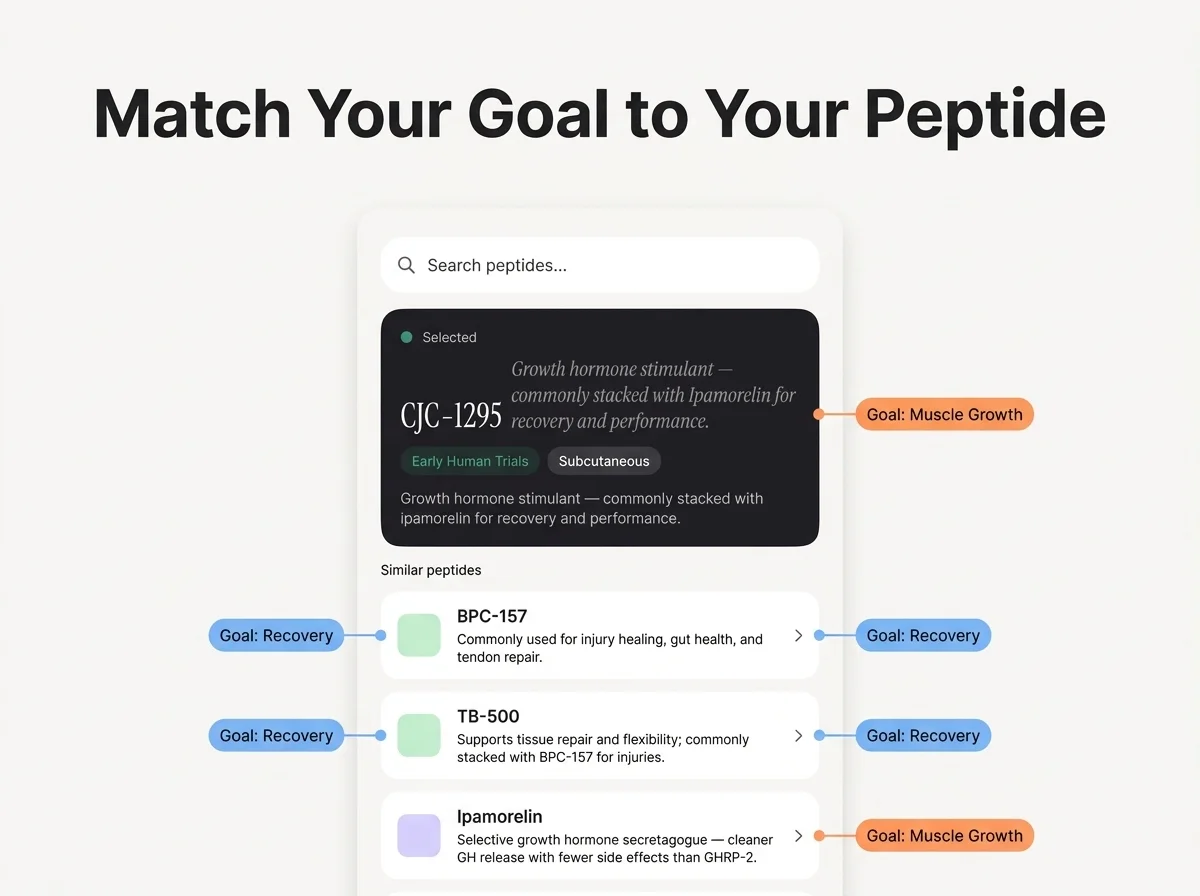 Selecting CJC-1295 surfaces goal-matched alternatives — BPC-157 for recovery, TB-500 for tissue repair, Ipamorelin as a muscle-growth pairing — with evidence level shown up front.
Each entry carries the same evidence-level badge used in the table above, plus a suggested starting dose and cycle length. Nothing about the goal-matching logic is hidden behind a paywall or buried in fine print — it's the first screen a new user sees.
Tracking Results Is What Matters
Choosing well is step one. The step almost everyone skips is logging what actually happens — energy, side effects, adherence — against the protocol they picked.
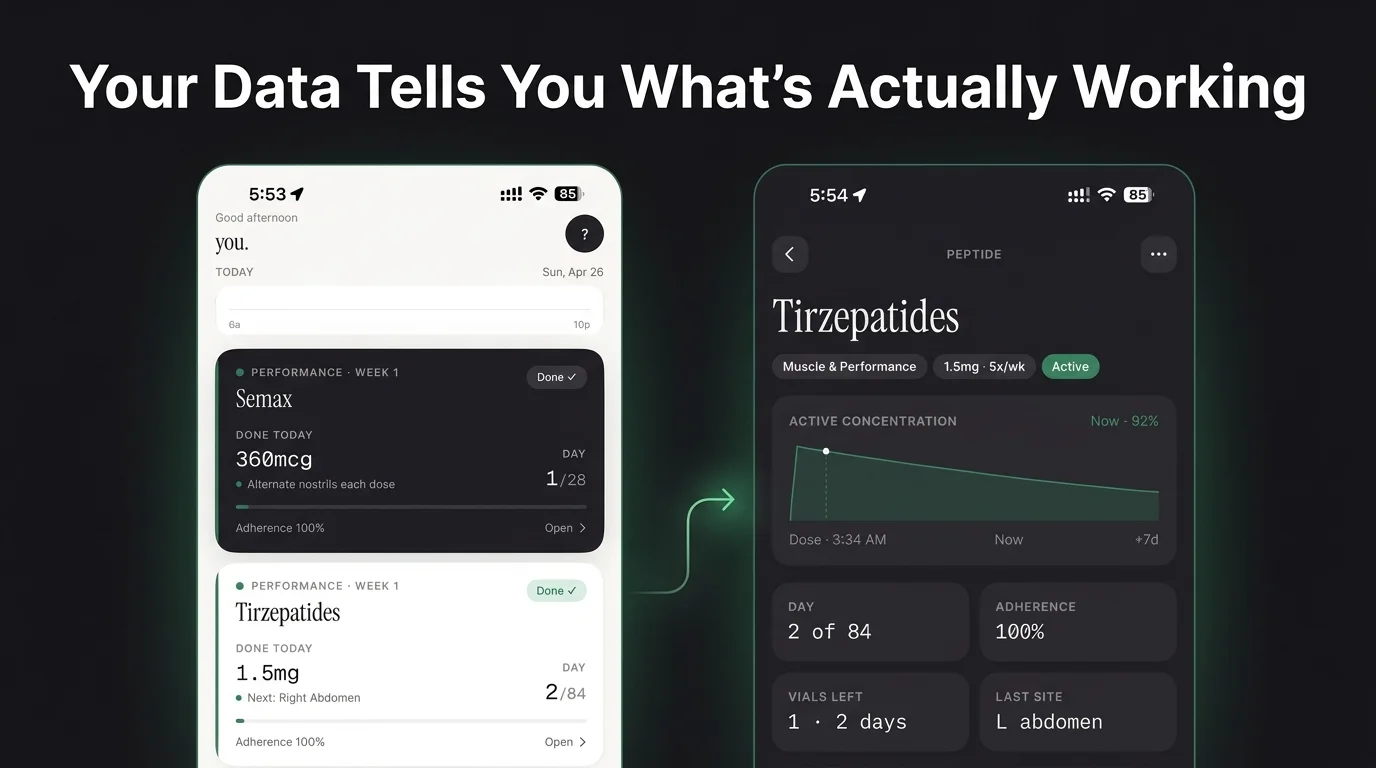 Two active protocols tracked side by side, with adherence, cycle day, and active concentration visible at a glance.
This is the piece a "best peptide" list can't give you. The perfect choice on paper still fails if you can't tell, three weeks in, whether it's working. PeptideIQ turns dose logs, wellness sliders, and side-effect entries into a week-by-week read on whether your specific protocol is on track — the same data a doctor would ask for, generated automatically instead of reconstructed from memory.
Should You Start with One Peptide or Stack Multiple?
Most people should start with a single peptide and run it for a full cycle before adding a second — stacking multiple compounds before you understand how one affects you makes it nearly impossible to tell what's actually causing a result or a side effect. This applies even to experienced lifters, not just first-time users.
Clive, a two-year peptide veteran, currently runs a growth hormone stack alongside BPC-157 for an old shoulder injury — but he got there by testing each compound individually first. That sequencing is what let him trust the stack once he combined them.
A single-peptide baseline also makes side effects easier to interpret. If nausea shows up while stacking tirzepatide with something else, you won't know which compound to blame without that baseline. The future article on side effects by peptide will go deeper on exactly this — for now, treat one clean cycle as the minimum before you stack anything.
So, What Are the 5 Best Peptides for You?
It comes down to your goal, not a ranking:
- Weight loss: semaglutide or tirzepatide
- Muscle growth: CJC-1295 + Ipamorelin
- Recovery: BPC-157
- Longevity: GHK-Cu
- Cognitive support: Semax
Pick the one that matches what you're actually trying to solve, start with a single protocol, and let a few weeks of logged results — not the label on the vial — tell you if it's the right one.
Get Started with PeptideIQ
Picking one of these five peptides is the easy part. Knowing whether it's actually working for you — instead of guessing based on how you feel on any given day — is what PeptideIQ is built for.
FAQ Section
What are the top 3 peptides people search for?
Search interest consistently clusters around semaglutide/tirzepatide (weight loss), BPC-157 (recovery), and CJC-1295/Ipamorelin (muscle growth) — the same three goals driving most peptide adoption since 2025's GLP-1 and BPC-157 attention spikes.
What peptide does Joe Rogan use?
Rogan has publicly discussed using BPC-157 as part of what he calls his "Wolverine stack" to help heal elbow tendinitis. That mention on his podcast, reaching roughly 35 million listeners, is widely credited with spiking BPC-157 search volume.
Is there a "most reputable" peptide?
Reputability tracks evidence level, not popularity. Semaglutide and tirzepatide are the most rigorously studied (FDA-approved), while BPC-157 and GHK-Cu have strong but not yet definitive human data — reputable, but not in the same evidence tier.
Is BPC-157 really the "king of all peptides"?
That nickname reflects BPC-157's broad use case — tendon, ligament, and gut healing — plus its outsized visibility after Rogan's podcast. It's popular and well-tolerated, but "king" is a reputation, not a formal evidence ranking.
How long before a peptide shows results?
Timelines vary by goal: weight loss peptides often show measurable change within 2-4 weeks, BPC-157 recovery is typically 3-6 weeks, and longevity peptides like GHK-Cu are usually judged over months, not weeks.
Can beginners safely combine two of these five peptides?
It's possible but not recommended as a starting point. Running one peptide first establishes a personal baseline for side effects and results, which makes any later stack far easier to evaluate honestly.